
At the time of writing this blog, PGPR consists of just two people – Johanna Spiers, the business owner – and Astrid Coxon, proofreader and qualitative expert extraordinaire.
In this blog, you can get to know Astrid and hear about why she will do an excellent job on your paper, essay or thesis. Astrid says…
On getting into qualitative research:
My qualitative education started when I studied health psychology at the University of Surrey, where I had the absolute privilege to be taught by (the now deservedly retired) Professor Adrian Coyle. As well as being playful and practical in his methods (teaching us the basics of thematic analysis by getting us to code Dolly Parton lyrics), he was also incredibly encouraging.

We bet Dolly loves qualitative research…
Photo by Wes McFee on Unsplash
I hear stories of psychology students getting the most brief and basic whistle-stop tour of qualitative methods, but we were supported to complete full projects following the famous six-step approach to thematic analysis (Braun & Clarke, 2006 ), which should be on a bingo card at qualitative conferences!
That experience completely changed the trajectory of my academic life. Before my time at Surrey, I was a dyed-in-the-wool* quantitative psychologist – now, I’m so far down the qualitative rabbit hole that I can barely remember the most basic functions in SPSS.
*Choice of wording deliberate – my project for Prof. Coyle’s module involved interviewing members of knitting groups!
On the qualitative projects she’s worked on:
I’ve been largely involved in healthcare-related research, including the stress experienced by ambulance dispatch personnel, the implementation of enhanced recovery hip fracture care pathways (my PhD research), and more recently, people’s experiences and perspectives of receiving medical test results via online patient portals.
On her favourite qual methods:
I’m a big fan of reflexive thematic analysis. Maybe because that methodology holds such fond formative memories for me (being the first approach I was taught), maybe it’s because Braun & Clarke are just very cool and actively involved people, maybe it’s because it’s so accessible and endlessly adaptable, or maybe because it’s the approach that spawned its own meme!
(Go and do an image search of the phrase “themes do not emerge” – and yes, I have the pin badge, and yes, it makes for a good conversation starter!)

On her proudest publication:
I’m not sure I can say it’s “mine”, but I think the paper I’m most proud to be co-author on is one first-authored by one of my MSc students. I work part-time as an online teaching fellow at King’s College London, and while I work with some brilliant students, the nature of the course (MSc Psychology & Neuroscience of Mental Health) and the timescale in which it’s delivered makes it quite rare for them to be able to conduct primary research for their dissertation projects (most will either do research proposals or critical reviews).
As a result, I don’t routinely get the privilege of supporting students to translate their dissertations into articles for potential publication. But last year, I was approached by a student (Steve Siddals – remember the name, I’m certain he will go far!) who was extremely passionate about his chosen topic (people’s experiences of using generative AI chatbots to support their mental wellbeing), and I supported him through the KCL ethics process, data collection, analysis and write-up.
After he finished his MSc, we translated his dissertation into an academic manuscript, which was published in NPJ Mental Health.
Here at PGPR, we love helping students
Note that you can read more of Astrid’s excellent publications via her Google Scholar page.
On getting involved in PGPR:
Johanna and I first met at a BPS Qualitative Methods in Psychology (QMiP) section conference in 2015 (at Anglia Ruskin Uni in Cambridge).
I was still a baby academic then – I’d only recently started my PhD and was still trying to feel my way around the weird and wonderful world of qualitative methods. Both Johanna and I had blue hair at the time, which is as good a reason as any to strike up a conversation with a stranger at a conference! Turns out, a groovy sense of style wasn’t the only thing we had in common, and I think we both had a feeling that we’d be in touch for the long haul.
In 2018, Johanna recommended that I take over as editor of the QMiP’s “Bulletin” journal and coached me in the early stages of that role. Then, a year later, Johanna got in touch about her proofreading business. She told me how busy things had been and asked if I would be interested in some work. The rest is history. It’s weird to reflect on how long ago that was.
Johanna and I have only actually been in the same physical space as each other a handful of times, but that hasn’t gotten in the way of a solid friendship!
On what she loves about PGPR:
I’ve had the opportunity to read some genuinely fascinating research that I wouldn’t have otherwise had cause to read. Whilst I do get to read some great dissertation projects by my MSc students, they all fall within my subject area (mental health of healthcare workers or therapy-adjacent topics) – working for PGPR, I’ve read about immigration law, peer coaching in the fire service, dogs in offices, and much, much more besides.
We can proofread research on dogs in offices – or even FROM dogs in offices!
Photo by Pavel Herceg on Unsplash
I particularly enjoy formatting work – there’s something very satisfying about applying consistent heading styles, table/figure captions, and generating tables of contents to produce a professional-looking document for a client. The final finishing touches make a big difference!
On life outside of PGPR:
When I’m not proofreading, I can either be found at the beach walking my dogs, or on the sofa knitting! Sometimes, I even knit for the dogs.
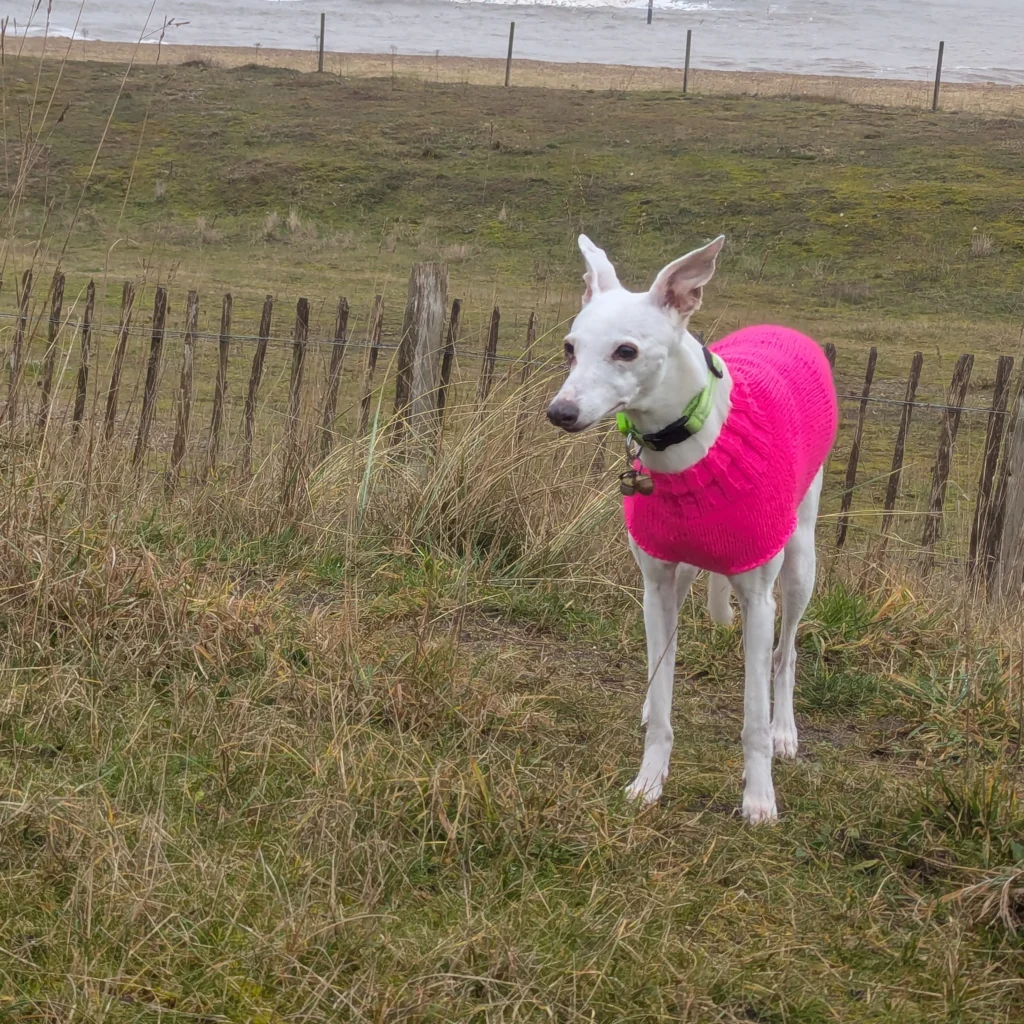
Ok, two pictures of dogs in a row – but who could resist this picture of Astrid’s dog in her knitted jersey?
If you want to book Astrid for any proofreading, feedback or formatting work, just get in touch via this box.