
Time and time again, our clients have to cut words from their theses so they can meet their university’s guidelines. This need to be ruthless with words continues after postgrad work. Grant proposals, book chapters and peer-reviewed papers often have word or character limits that must be followed. Additionally, omitting needless words is just a good rule of thumb, no matter what you’re writing. Short sentences are impactful!
However, writing tight can be extra challenging when you’re a qualitative researcher. For a start, our data takes up far more words than for quant people, yet we often still have the same word counts to contend with. Secondly, our interpretations can be complex, feeling as though they need paragraphs of text to be properly unpacked. Trying to cram all our lovely findings into a draconian word count can feel impossible at times!

Photo by Andre Hunter on Unsplash
Fortunately, we at PGPR have years of experience with trimming down qualitative PhDs so that they are the required length and yet still contain the depth and nuance needed. Here are some of our top tips for writing qualitative research as succinctly as possible.
- Watch out for written tics
We all have stock phrases that we fall back on and reuse when we’re speaking or writing. These are often overly wordy at best and totally unnecessary at worst. They might include wording such as:
- It appears that the participants expressed…
- It is interesting to note that…
- It could therefore be suggested that…
- Research carried out by Smith et al. (2012) found that…
- In order to…
- Due to the fact that…
- A number of…
All these overly wordy phrases can be replaced with more succinct alternatives, as shown below…
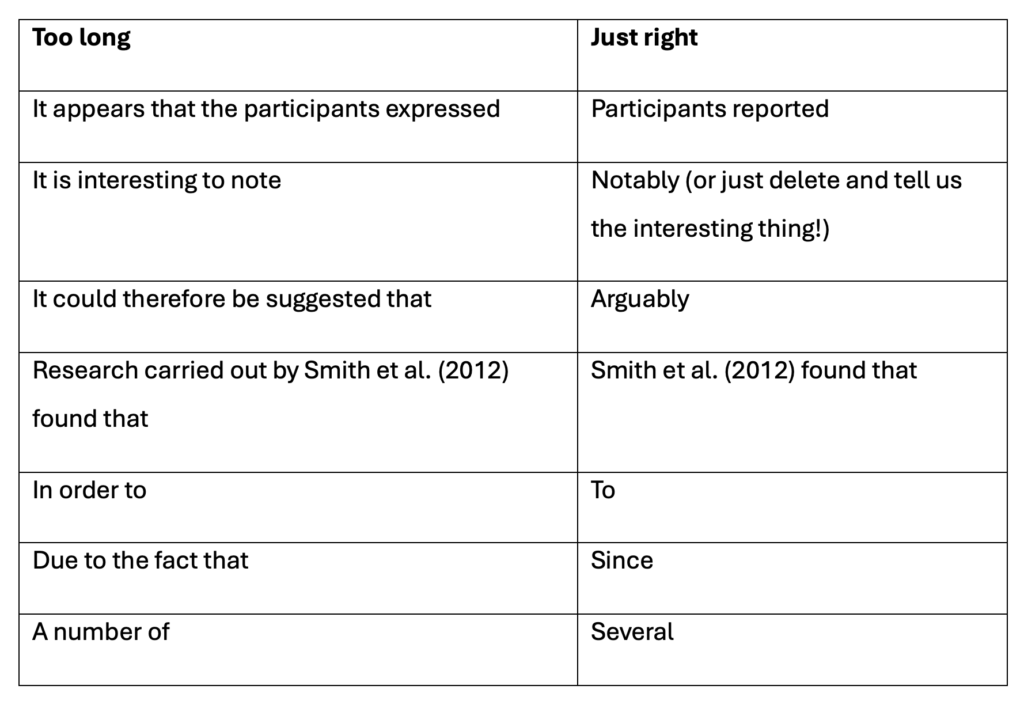
Read some of your work back and look out for phrases like this that you over-use, then use the search function to find all examples. You’ll be able to cut many of these back, which will have the dual benefit of getting you closer to your word count and making your work more readable.
(NB: don’t just do a find and replace – find each instance and use your judgement to work out whether it can be replaced and if so, what with!)
- Put your work down for a few days
In addition to these common phrases, many qualitative students tend to write in a flowery, verbose way. This is fine for a first draft. Indeed, I don’t recommend even trying to think about word count while you’re getting your initial ideas down. Capturing your interpretations and ideas is far more important in the early stages of writing.
However, if you put your too-long chapter down for a couple of days and then come back to it with a clear head, you’ll almost certainly start to spot unnecessary words. Reading your work aloud really helps with this, so if you’re struggling, try reading a page or so to yourself. You’ll instantly see cuts you can make – and then you can apply that same thinking to subsequent pages.

Photo by Artem Beliaikin on Unsplash
- Trim data
As mentioned above, the data we deal with as qualitative researchers is one of the reasons we can struggle with word counts. Of course, it’s important to ensure that you are including quotes that are long enough to illustrate all the interpretations you’re making.
However, it’s often the case that a bit of data can be trimmed off the beginning or end of a long quote. Or maybe there’s a section in the middle that is less relevant? If so, you can take this out, as long as you use some notation to mark this. […] is a common way to demonstrate the removal of less relevant material.
Be careful here – don’t take out sections of data that point to a different interpretation than the one you want to make, just to strengthen your argument! Data like this must stay in and be considered. However, if the participant says something in the middle of a quote that is just not relevant to this subtheme topic, it’s fine to take it out.
- Stay laser-focused on your theme topics and research questions
And speaking of subtheme topics – one of the most common problems I see in my clients’ work is that data and interpretations are presented that are lovely, but not actually relevant.
Remember that no matter which qualitative method you’re using, all the material you present under a section or subtheme must feed into that topic. Similarly, each subtheme or lower-order section should feed into the higher-order theme or section. And everything you discuss in the findings section must be relevant to your research question.

Photo by Erfan Afshari on Unsplash
While the tips I’ve offered so far are all about trimming individual sentences, this final tip can help you to remove whole paragraphs or even pages that you don’t need. This can be painful if you’ve spent a long time reaching this interpretation, but if it’s not relevant to your research question, I’m afraid it belongs on the cutting room floor!
- Book PGPR
If all of this feels too much like hard work, get in touch with PGPR via the contact form below, and we help you to cut your thesis down to size by trimming individual sentences and suggesting larger areas that you may be able to edit down. We’ll be happy to help!