Time and time again, our clients have to cut words from their theses so they can meet their university’s guidelines. This need to be ruthless with words continues after postgrad work. Grant proposals, book chapters and peer-reviewed papers often have word or character limits that must be followed. Additionally, omitting needless words is just a good rule of thumb, no matter what you’re writing. Short sentences are impactful!
However, writing tight can be extra challenging when you’re a qualitative researcher. For a start, our data takes up far more words than for quant people, yet we often still have the same word counts to contend with. Secondly, our interpretations can be complex, feeling as though they need paragraphs of text to be properly unpacked. Trying to cram all our lovely findings into a draconian word count can feel impossible at times!

Writing succinctly can feel frustrating for qual researchers Photo by Andre Hunter on Unsplash
Fortunately, we at PGPR have years of experience with trimming down qualitative PhDs so that they are the required length and yet still contain the depth and nuance needed. Here are some of our top tips for writing qualitative research as succinctly as possible.
Watch out for written tics
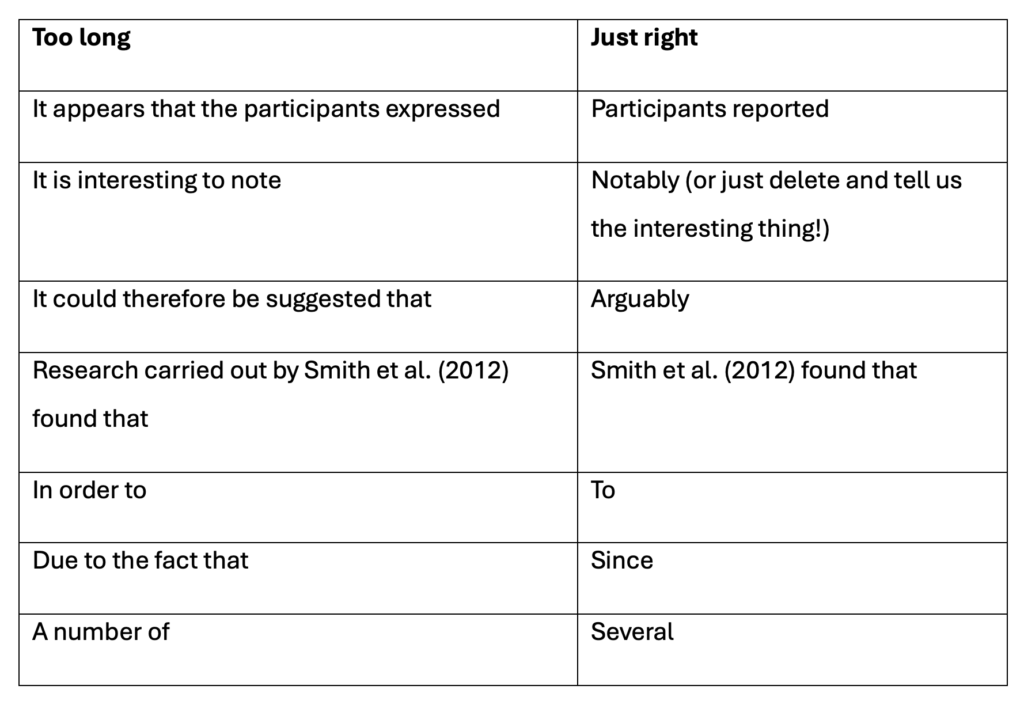
We all have stock phrases that we fall back on and reuse when we’re speaking or writing. These are often overly wordy at best and totally unnecessary at worst. They might include wording such as:
It appears that the participants expressed…
It is interesting to note that…
It could therefore be suggested that…
Research carried out by Smith et al. (2012) found that…
In order to…
Due to the fact that…
A number of…
All these overly wordy phrases can be replaced with more succinct alternatives, as shown below…
Read some of your work back and look out for phrases like this that you over-use, then use the search function to find all examples. You’ll be able to cut many of these back, which will have the dual benefit of getting you closer to your word count and making your work more readable.
(NB: don’t just do a find and replace – find each instance and use your judgement to work out whether it can be replaced and if so, what with!)
Put your work down for a few days
In addition to these common phrases, many qualitative students tend to write in a flowery, verbose way. This is fine for a first draft. Indeed, I don’t recommend even trying to think about word count while you’re getting your initial ideas down. Capturing your interpretations and ideas is far more important in the early stages of writing.
However, if you put your too-long chapter down for a couple of days and then come back to it with a clear head, you’ll almost certainly start to spot unnecessary words. Reading your work aloud really helps with this, so if you’re struggling, try reading a page or so to yourself. You’ll instantly see cuts you can make – and then you can apply that same thinking to subsequent pages.

Taking a break can help you work out which words you can cut Photo by Artem Beliaikin on Unsplash
Trim data
As mentioned above, the data we deal with as qualitative researchers is one of the reasons we can struggle with word counts. Of course, it’s important to ensure that you are including quotes that are long enough to illustrate all the interpretations you’re making.
However, it’s often the case that a bit of data can be trimmed off the beginning or end of a long quote. Or maybe there’s a section in the middle that is less relevant? If so, you can take this out, as long as you use some notation to mark this. […] is a common way to demonstrate the removal of less relevant material.
Be careful here – don’t take out sections of data that point to a different interpretation than the one you want to make, just to strengthen your argument! Data like this must stay in and be considered. However, if the participant says something in the middle of a quote that is just not relevant to this subtheme topic, it’s fine to take it out.
Stay laser-focused on your theme topics and research questions
And speaking of subtheme topics – one of the most common problems I see in my clients’ work is that data and interpretations are presented that are lovely, but not actually relevant.
Remember that no matter which qualitative method you’re using, all the material you present under a section or subtheme must feed into that topic. Similarly, each subtheme or lower-order section should feed into the higher-order theme or section. And everything you discuss in the findings section must be relevant to your research question.

Staying laser-focused on your thematic points and research question will help you write succinctly Photo by Erfan Afshari on Unsplash
While the tips I’ve offered so far are all about trimming individual sentences, this final tip can help you to remove whole paragraphs or even pages that you don’t need. This can be painful if you’ve spent a long time reaching this interpretation, but if it’s not relevant to your research question, I’m afraid it belongs on the cutting room floor!
Book PGPR
If all of this feels too much like hard work, get in touch with PGPR via the contact form below, and we help you to cut your thesis down to size by trimming individual sentences and suggesting larger areas that you may be able to edit down. We’ll be happy to help!
Congratulations – you’ve written a paper based on your qualitative study, and now you’re deciding where to try to publish. That’s fantastic! Getting a few peer-reviewed publications under your belt is an essential step in the academic career path. However, if you’ve not done it before, the publication process can feel daunting. Don’t worry: PGPR are here to guide you.
Congratulations: You’re ready to publish! Photo by Yen Vu on Unsplash
Selecting a journal
Make a list of journals that publish in your area
The process of reading existing research and writing your reference list will mean that you have almost certainly internalised the names of more relevant journals than you think. Jot those down, then look through your reference list for others you haven’t remembered. Ask your co-authors for their ideas. Do a Google search for ‘journal’ + your topic. This should result in a good list for you to consider.
Check which are open to publishing qualitative research
This is essential! There is no point submitting your study, beautiful as it might be, to a journal that has never published any qualitative work before. Doing so will waste both your time and the editors’ time, so do everyone a favour and search the archives of your longlisted journals for the word ‘qualitative’ in the titles of published articles. If there are none, cross that one off your list.
Ideally, you want to find a journal that often publishes qual work and has published at least some articles using your methodology. Of course, there are some qual-specific journals out there, such as Qualitative Research and the Journal of Qualitative Health Research. These will always be open to qualitative work, and their reviewers will have the expertise to provide relevant, helpful feedback.
Check your chosen journal publishes qualitative research before submitting. Photo by Yen Vu on Unsplash
Make a table of each journal’s attributes
This table should include the journal’s impact factor – a number that indicates how often papers from this journal are cited and so how prestigious the journal is – their word count (you can’t publish three GETs from your beautiful IPA study in a journal whose maximum word count is 2,000), who the readers of the journal are, whether or not it is open access and so on. It could be that your co-authors have had good or bad experiences publishing in the papers on your list; if so, include that too.
Note that if you are choosing to publish in an open-access journal, your university will need to pay some rather weighty fees, so do check that they have the budget for that before pursuing that route.
Rank journals in order of preference, depending on your priorities
Looking at this information in table form will help you decide which journal to target first. If you have high ambitions for forging a lofty academic career (and why not?), aim for the high-impact journals first. Just be prepared for the potential of a knock-back, and be ready to move on to the next journal on the list. If your priority is to get your research seen by other qual researchers sooner rather than later, consider a less high-impact journal with a stronger proven track record for qual researchers. (Unfortunately, these two things often go hand in hand!)
For what it’s worth, I don’t think that impact factors mean much more than a plus point on your CV. I don’t know of any academics who find papers to read based on the impact factor of the journal. Instead, just as you very likely did, other academics use Google Scholar to look for papers in the relevant area, read them, and cite the best ones, often not worrying at all about which journal those papers are in. So I never really worry about impact factors. However, if you are more ambitious in that area, I doff my cap to you and wish you the best of luck.
Deciding which journals to target takes some thought. Photo by No Revisions on Unsplash
Read through the author guidelines of your chosen journal
Once you’ve decided on your ideal journal, the next step is to carefully read over the author guidelines and ensure your paper follows them. This might involve changing your references from APA7 to Harvard (not an issue if you’ve used referencing software – a right pain if you haven’t, I’m afraid!), cutting a few words or changing from UK to US spelling. Following the guidelines as closely as possible at this stage will save you hassle later on. I recommend saving a new version of the paper and adding the journal to the title so you can revert to your original if it isn’t accepted the first time.
Ensure you have cited any relevant papers from your chosen journal
This is self-explanatory! Do a quick search of recent editions of your chosen journal and include any relevant references. This will show the journal’s editors that you’ve paid attention to their publication.
Write a killer cover letter
Ensure you’ve written a confident and concise cover letter before you start the submission process. This is your chance to tell the editor why their publication and readership need to read your amazing research. Again, check the author guidelines for any instructions on what to include in the letter for your chosen journal.
Sadly, academic publishing involves some rejection. Photo by Steve Johnson on Unsplash
8. Be prepared for some rejection
Unfortunately, publishing academic work comes with its fair share of rejection, which can sting, especially when you’re starting out. Give yourself a day or two to feel the pain, then move on to the next journal. Keep working through your list until you find someone who recognises your genius and says yes!
If a journal rejects your paper but gives you some feedback, read that feedback carefully. If the reviewers have said anything you agree with, redraft the paper to smooth out those issues. If you don’t agree, move on. The good news is that the longer you do this, the easier it becomes to shrug off any difficult feelings that come with rejection and keep moving forward.
Submitting your paper involves filling out a long, complex online form and is often more frustrating than you want it to be! Give yourself a good hour or so to complete this process, and ensure that you have all relevant info to hand before you get started, such as your co-authors’ contact details and your cover letter. If possible, look through the form before you get started so you can spot anything you might need to ask your supervisor about in advance.
One thing you will need to do is nominate peer-reviewers; that is, experts in your field who you would ideally like to review your paper. Peer reviewers decide whether your work is ready for publication and, if not, what needs to change. It is extremely rare for a paper to be accepted with no revisions, so be ready to respond to your reviewers’ comments before publication.
How to nominate peer reviewers:
Have this discussion with your co-authors before you submit
It’s really frustrating to be 75% of the way through submitting your paper before you realise that you haven’t discussed potential reviewers with your co-authors, as that means you have to pause the process to have that conversation. Therefore, I recommend going into the submission process with a list of agreed-upon potential reviewers to nominate, along with their institutions and contact details.
Talk to your co-authors about which peer reviewers to nominate. Photo by Brooke Cagle on Unsplash
2. Who can’t review your work?
For obvious reasons, you cannot nominate current or recent co-authors, someone at your institution, a mentor, close colleague or friend. Therefore, tempting as it might be, don’t put any of those friendly faces on your list.
3. Who should review your work?
As mentioned above, your nominated reviewers should be experts in the field. I believe it’s more important that these people are qualitative researchers (or at least open to qualitative research) than that they are well-versed in your exact topic. Otherwise, you run the risk of reviews from people who don’t understand qualitative research and will waste your time asking about generalisability or insisting that you should have reported data saturation in your three-participant IPA study. If you can think of people who are qual researchers and also experts in your topic, all the better. You can find people like this by looking at who wrote the work you’ve cited and asking your co-authors for ideas.
4. Make sure you’ve cited their relevant work
Once you’ve decided on a few names, check whether these people have published a relevant paper that you have somehow missed. If you find something important, cite it. Everyone is susceptible to flattery. Plus, if the work is relevant, the reviewers will certainly point out that you’ve missed it, so this saves everyone time.
Make sure you’ve cited your ideal peer-reviewers in your paper. Photo by Daniel Thomas on Unsplash
5. If possible, list more than two people
Bear in mind that your nominated reviewers are not under any obligation to say yes. Academics are stressed, busy people and reviewing is not paid work. For example, I probably review only one in every five papers I’m asked to read. I say no to any quantitative papers or those I have no expertise in at all (so again, do everyone a favour and only nominate people who have the relevant knowledge), but also have to say no to some fascinating-sounding papers because I don’t have the time to read them. Therefore, the longer your list of potential reviewers, the better.
In my experience, if a paper is about a strong, important study and you are targeting relevant journals, you will only need to try two or three publications before you find the right home for your work. The more experienced you become at this, the more likely it is that you’ll find the right journal the first time around.
If you need any help preparing your study for publication, contact PGPR using the form below. We are qualitative experts who offer proofreading and feedback to postgrad students like you.
PGPR is the brainchild of Johanna Spiers, business owner, qualitative researcher and proofreader extraordinaire. Johanna loves running PGPR and working with her clients, and she appreciates how hard it can be to turn the thesis you’ve spent months and years working on over to her to edit and/or critique.
As such, we thought it might be useful for Johanna to share a bit about who she is, where her training comes from and how she came up with the idea for PGPR. We’re hoping this will help you feel confident that your work will be in good hands when you send it to us.
Johanna is happy to help with all your proofreading and feedback needs
Johanna says…
On getting into qualitative research
My first qualitative study was an undergrad IPA project that I completed under the guidance of Jonathan A Smith at Birkbeck University. The project was about academic mothers juggling their work and family demands. I was hugely lucky to be supervised by the man who created IPA; I found his insights and tutelage inspirational.
I came from a creative background – my first degree, completed back in the late 1990s, was in creative writing, and when I’m not helping PGPR students, I write fiction. I love exploring the nuances of words and delving into their deeper meanings. Plus, I’ve been drawn to understanding relationships and diverse perspectives since childhood.
As such, I found IPA’s combination of deep, idiographic textual analysis and psychological underpinnings hugely attractive.
Indeed, I loved doing that study so much that I applied to do my PhD with Jonathan as soon as my undergrad was over. My PhD – which was about the experience of living with and being treated for renal failure – led to three publications, which you can read here, here and here.
Johanna’s first qualitative project was about working mothers
On the qualitative projects she’s worked on:
Since finishing my PhD, I’ve worked on research projects at universities including Hull, Bristol, UCL, Birmingham and Surrey. The topics I’ve researched have tended to be related to health conditions – either physical or mental – and include areas like living with an ileostomy, the mental health of healthcare professionals, adherence to HIV medication and an evaluation of a dementia healthcare program.
While I have continued to use IPA, my first (and true!) qualitative love, I’ve also been fortunate enough to work on studies which required me to use a range of other methodologies, including thematic analysis, grounded theory, realist evaluation and even, on one shocking occasion, quantitative methods.
I’ve also co-authored several literature reviews, including an integrative review of postvention guidance and a rapid review of reviews of dementia healthcare programs (in press).
This experience means that I am well qualified to offer feedback on a range of studies and methodologies – so your work is in good hands when you send it to me.
Your work is in good hands when you send it to PGPR
Of all the research I’ve worked on, I have felt most passionate about the series of studies I completed with Dr Ruth Riley about various aspects of healthcare professionals’ mental health.
I love our NHS and feel very strongly that it needs to be better funded and the staff who work for it better looked after. As such, being able to speak first-hand to GPs, junior doctors and a range of other NHS workers about their jobs and mental health was a true privilege.
My proudest – and most cited! – paper comes out of one of those jobs. This is a paper I especially love because it highlights some of the struggles faced by NHS workers whilst also offering help to qualitative students, as I explain how to analyse one dataset (about the distress of GPs) with both IPA and thematic analysis.
As I mentioned above, I started life as an editorial person rather than a scientist. After completing my degree in creative writing, I moved back to my hometown of London and worked in the editorial world, writing Teletext (remember that??) for various cable channels and then sub-editing copy on a range of magazines and newspapers.
This work taught me how to make words work in the most efficient way possible. At the same time, I continued to work on my fiction (an example of which you can read here, if you’re interested).
While I was doing my PhD, I worked on the QMiP Bulletin, eventually serving as editor for a brief spell. I think I rather terrified everyone else on the team by introducing glossy magazine-level proofreading standards to what was a volunteer position. I loved that work – combining my new psychology knowledge with my trusty editorial skills felt like a dream for me.
In 2017, I finished work on a postdoc study at Bristol and started applying for lecturing positions. However, my heart wasn’t really in the search – lecturing looks like arduous work (hats off to all the supervisors out there toiling away at the frontline!) and I was still plugging away at my fiction writing.
So I decided to see if any postgrad students wanted help proofreading their theses, something I felt uniquely qualified to offer.
I was amazed by the response – PGPR has been running ever since then!
PGPR has been helping postgrad students since 2017
On PGPR’s journey
PGPR has undergone several iterations in the nine years it has been running. At first, it was just me and my laptop. However, I was so quickly overwhelmed by clients that I started recruiting other qualitative and editorial experts to take on the work I didn’t have time for.
At one time, PGPR had 10 proofreaders on the books, a fantastic admin assistant and a business manager.
These days, we’re a more humble affair: it’s now just me and Astrid taking on work, and I’ve gone back to doing all my own admin, meaning you get the personal touch from the moment you contact us.
I love the proofreading work I do for all you lovely students. I get to read about such a range of fascinating topics. My clients are a warm, clever and funny bunch, and I feel lucky to be able to help them on their roads to success. I love hearing about vivas passed and papers published.
If you’d like Johanna to proofread some of your work or offer feedback, you can get in touch via the form below. She’ll be happy to hear from you!
In a previous post, we covered some of the common problems we support postgrad qualitative students with, to help you to tighten up your writing. In this post, we’re covering a few more.
1. Overuse of conjunctive adverbs
Conjunctive adverbs are words or short phrases used to transition from one clause to another. You’ve used them all your life, and you might not have known they had a term – words like “however”, “moreover”, “in conclusion” and “additionally” are all conjunctive adverbs, and can be useful for creating narrative direction or emphasis. However, over-use can make your writing clunky, cluttered and overly formal. Moreover, starting every sentence with a conjunctive adverb can be a jarring reading experience, detracting from the content of your writing.
Take those two previous sentences as an example; arguably (there’s another one), the “however” is a useful signifier of a change in direction (from the “usefulness of conjunctive adverbs” to “writer beware”). The following sentence didn’t need to start with “moreover” – it stands up fine on its own. I could have started the sentence before this one with another conjunctive adverb, such as “Arguably, the following sentence…”, but did it need it? Arguably, it didn’t. Next time you review your writing, try highlighting every time you use a conjunctive adverb – can some of them bear pruning?
Conjucntive adverbs can be useful linking devices but use them sparingly!
2. Badly positioned ordinal and sequencing adverbs
In academic writing, we often use ordinal or sequencing adverbs to structure points in our argument – firstly, secondly, lastly, finally. They can help your reader to identify discrete points within a broader claim, or guide them through the order of your ideas. But use them wisely!
If you’re going to use ordinal adverbs, use them clearly and consistently – for example, if you tell your reader that there are three main criticisms of a theory, don’t start with “firstly” and then fail to indicate “secondly” and “thirdly”, as they may not be able to clearly identify where one criticism ends and another begins.
If you start a clause with “finally” or “lastly”, it really should be the final or last clause of that argument – don’t use “finally” in the middle of a paragraph and then go on to make several other points related to the argument.
3. Making analytical claims that aren’t properly supported by data
A common refrain from markers and reviewers everywhere is “citation needed”, usually referring to claims made that aren’t supported by published peer-reviewed literature. If you’re a qualitative researcher, you also need to ensure that analytical claims are clearly supported by your data. When you make statements about the phenomenon you’re researching, is it evidenced in the data you’re presenting, or does it just “feel right”? Make sure that your reader can follow your reasoning by presenting relevant quotations from your participants and explaining your analytic process.
4. Hedging
In writing, “hedging” is using language that indicates uncertainty. You might be familiar with the term “hedging your bets”, to protect yourself from potential losses by placing bets on multiple possible outcomes.
Sometimes, hedging can be appropriate, such as when you are exploring multiple possible interpretations of findings (e.g., “this may indicate…”). However, don’t hedge everything – overuse of hedging can make your writing less direct or certain, and this isn’t appropriate when you are stating things that are certain or unambiguous.
For example, instead of writing “In this chapter, I hope to demonstrate…”, simply state “In this chapter, I will demonstrate…” – not only will this make you sound less apologetic, but it also improves clarity and conciseness, reducing the burden on your reader (who otherwise has to cut through the waffles of mights and maybes!)
Clear metalinguistics – explaining “this is what I’m going to cover” and “in summary, this is what I’ve covered” – can be useful to guide your reader through your writing, but don’t overdo it. If you have just explained something in good detail, don’t start the subsequent subsection with a summary of what you’ve just covered. Not only is this repetitive, but the extra clutter it creates potentially makes it harder for your reader to follow the narrative thread of your writing.
Need help pruning your hedging or ordering your adverbs? We can help you to make your writing shine – just contact us via the box below!
Here at PGPR, we’ve been helping postgrad qualitative students polish and refine their work since 2018. We love our work and our clients – you guys are dedicated, friendly and warm, and you all do such amazing research. We always enjoy helping you, so in that spirit, here’s a list of some of the problems we see cropping up time and time again – and some ideas for how to avoid them.
1. Dictionary swallowing
Postgrad work is a few steps up from undergrad – steps that can initially feel huge and intimidating. One of the hardest things can be getting to grips with all the new terminology you’re suddenly dealing with.
Phenomenology, hermeneutics, heuristics, epistemology, ontology – it’s enough to make your head spin.
Getting to grips with all these concepts and presenting your understanding of them can be tricky. Making it even more complex is the fact that academic writing follows a particular style and has certain (often unspoken) rules.
Read the dictionary by all means – but don’t swallow it!
A common response to these factors is to write in sentences and paragraphs that are so chock-full of multi-syllabic words and awkward passive phrasing that they must be read six times to be understood. So where you could have said:
Ontology and epistemology are two key ideas in philosophy that help us understand reality and knowledge.
Instead, you will say:
Ontology and epistemology constitute the foundational pillars of philosophical inquiry, delineating the fundamental nature of reality and the mechanisms through which knowledge about that reality is ascertained.
As you can see, this longer and more complex sentence is in no way better. The first and best rule of any writing is ‘omit needless words’ (Strunk and White, 1918), and that definitely applies here.
When we at PGPR see language like this, it can make us wonder whether the client really understands what they are describing. Therefore, first, check that you fully understand the concepts you’re writing about. Try explaining them to a friend and then writing that explanation down. What you get from this exercise will almost certainly be better than striving to write in ‘academise’.
Try checking out this quick video where Steven Pinker explains why many academics write so badly – it’s not just the students who do this!
2. Analytical teething troubles
A common problem with qualitative work is that the analysis needs to be refined further. Perhaps you need to dig deeper into the participants’ language. Maybe your themes read like a list of different experiences rather than a discussion of what brings those experiences together. It could be that those themes or codes are disorganised.
If this is the case for you, fear not! Qualitative analysis is hard, and it’s rare for students (or academics) to get it ‘right’ the first time. Collaboration and inspiration from supervisors, colleagues, research groups or from PGPR can be beneficial for pushing your ideas forward and doing justice to your lovely data.
If you could do more with your data, contact us via the box below and you can book in for some feedback.
3. Not knowing when to quit…
When writing a postgrad thesis, you’re a bit like Aerosmith – because you don’t want to miss a thing. You’ve put your blood, sweat and tears into this thesis, so it’s entirely understandable that you will want to ensure nothing gets missed out.
Since the thesis is your baby, it might be hard to determine what needs to be included and what is less essential.
Additionally, many of our clients have trouble trusting that readers are paying attention to their work, which means they can repeat the same ideas and concepts, in the same level of detail, many times throughout their thesis.
If you’re struggling with your word count, put your thesis down for a bit. Returning to it with fresh eyes will help you spot areas you can cut out or points you’ve repeated.
Plus, did you know that PGPR offers a word reduction service? We can cut up to 20% from your work for a small additional fee when you book in for proofreading. Another pair of eyes can be useful in murdering those darlings and getting your work as sharp and shiny as a diamond.
The table of contents (or the ToC) can be a puzzling beast to get right. Page numbers will keep shifting as you keep adding to your masterpiece. Headings and subheadings shift around and get amended – and many of our clients think they need to deal with this manually.
Here’s the fantastic news – you can leave your ToC to us entirely. With just a few simple clicks and highlights, our formatting whizz Astrid can create an interactive table of contents that you can update when you amend your thesis.
If you’re coming unstuck with your ToC, book in for our formatting service and we will do all the heavy lifting for you.
Look – we get it. Time goes quickly, life is hectic. All of a sudden, your postgrad deadline is only two weeks away, and you still haven’t booked that brilliant proofreading and feedback service you heard about. (That’s us, BTW!) If this is you, don’t worry – we will do our best to still fit you in.
However, if you can send your work earlier, we hugely recommend this. Why? Well, for a start, a longer period between us looking at the work and you submitting your thesis gives you longer to respond to our amendments. This is especially useful if you’ve booked feedback. Sometimes an analysis chapter might benefit from two rounds of feedback, which means that waiting until you’ve dotted all the ‘i’s, crossed all the ‘t’s and are eager to submit can lead to problems.
Of course, sometimes we are fully booked, so if you wait until the last minute, we might be unable to help you, which would be a shame.
We’re happy to look at individual sections of your thesis over weeks, months or even years. You don’t have to wait until everything is finished to book our services. If you’ve got a lit review you’ve finished but you’re waiting for ethics to come through so you can recruit the participants, send us that lit review and you can be doing your amends while you wait. And then when the deadline comes around, you’re ahead of the game and can smile the smile of the smug!
Whatever your issue, if you’re a postgrad qualitative student needing extra help, we are here for you. Just contact us via the box below and tell us what’s going on for you.
If you’re working on the final stages of your thesis, there’s probably a lot of writing going on in your world right now. It’s also likely that you’re juggling that with a job, cooking dinners, spending time with your family and trying to get out of the house once a day for fresh air. Therefore, despite your best intentions, writing might not be happening as often as you’d like.
Here are
some tips for carving out some time every day to get those brilliant findings
and interpretations committed to the page.
1. Plan
ahead
As much as possible, try to plan your weeks so that writing time is scheduled. Of course, life is unpredictable and sometimes we can’t stick to our plans, but if you at least know what you’re aiming for, you’re more likely to get there. If your schedule looks jam-packed, try to think creatively. Can you get up earlier a couple of days a week? Work in the evening while everyone else is watching TV? Get the kids to make the dinner one night so you can spend that time working? (Age of child dependent, of course!)
2. Tell
your housemates/partner/family that you have to shut the door
If you’re a housemate, a mother, a father or a spouse, you might feel that you need to drop everything the moment you’re needed by the people you love. Genuine emergencies aside, this is not the case. Can you set a time for working when you tell everyone that you’re not to be disturbed? Even if it’s only for half an hour a day, those half-hours will start stacking up, and so will your word count.
Setting clear boundaries with your loved ones is essential when working on a big project!
There’s no
point telling your family that the door is shut if you’re going to spend all your
time behind that closed door frantically checking Twitter and replying to your
favourite WhatsApp group chats. Put your phone on silent, don’t open your
emails and try to resist the urge to start Googling things as you write – it’s
all too easy to fall into an internet rabbit hole that way. You can always look
up how to spell phenomenological later; for now, just fudge it and get those
words down.
4. Recognise and reward the wins
Writing a thesis is really hard, even when there isn’t a global pandemic. You are doing an amazing job and you deserve to be rewarded. Sadly, most of the time, everyone else is too wrapped up in their own challenges to recognise how awesome you multi-tasking postgrad students are, which means you might need to reward yourself. And that’s just dandy, cos no one knows what you like better than you do! If you pass a milestone, no matter how small, book yourself a day off, buy your favourite cake, settle down with a novel and convince your other half to rub your feet. You’ve earned it.
Celebrating those wins along the way will help you eventually cross the finish line!
It can be
really tempting to start setting yourself huge targets: I’m going to write
2,000 words every single day without breaking a sweat. Sound familiar? The
problem with these unrealistic targets is that if you can’t stick to them, you
might start feeling discouraged, which makes it harder to come to your desk
feeling positive and energised the next day. Plus, if you know you don’t have
time for your 2,000 words that day, you might think well, there’s no point
starting – I’ll begin tomorrow instead. You can see how this thinking can
quickly lead to a week with no words written at all. Some of you might find it
easier to set a time limit for each day instead or to think in terms of
sections per week.
Do you have any tips for writing every day? Do let us know if so. And of course, once you’ve finished writing, you can always book us to proof-read your work so that you can be confident it’s as polished as it can be.
If you’d like to book PGPR to help you with your writing, just get in touch via the form below.
By this stage in your postgrad journey, you have probably read thousands of academic papers – or at least it feels that way. Indeed, you may have written one or two as well. But was the process quick and painless – or did it involve tears, tantrums and having to cut far too many of your carefully honed words? If you fall into the latter camp, you’ve come to the right place. Don’t panic; paper writing is challenging at first. But the more you practice, the slicker the process gets.
The method section is the simplest section of the paper. What did you do? Can you remember? If so, write it down. Check your target journal to see whether they have certain subheadings they want you to include (examples might be data collection, analysis, ethics and so on). If they don’t, have a look at other papers and copy their headings. Writing this short, factual series of paragraphs gets you into your stride and breaks that terrifying ‘blank page’ syndrome.
If you can, it’s often a good idea to start writing your method section while you’re still conducting the research. This ensures that you don’t forget any of those details about exactly where you found participant 14 or when you made those all-important changes to your interview schedule.
2. Use your table of themes to create your findings section
The findings are the most important section of a qualitative paper. This should be the longest and most detailed element and will guide the material you include in your introduction and discussion sections. This is why, once you’ve got started with the super-simple method, you should tackle the findings next.
You’ve got a table of themes that you lovingly created during your analysis, right? Well – I say lovingly created – what I mean is wrote, crossed out, re-created, kicked down the stairs a few times and cried over until you reached this final draft. Am I right?
Well, there’s good news and bad news. The good news is that (nearly all) of the hard work is already done. Created correctly, your table of themes should be the blueprint for your findings section. This means that you already know what points you want to make, in what order, and supported by which quotes. Brilliant, right? Well done past you. In theory, all you need to do now is turn write about why you named the themes and subthemes as you did, how those ideas are supported by the quotes and any interplay between the themes. With the right table of themes, this is easier than it sounds – the section almost writes itself.
The bad news – which really isn’t all that bad – is that analysis continues during writing. This means that, as you write your findings up, you are likely to realise that some quotes don’t quite do the right job, or that some points need shuffling around. You might need to seek out some different quotes, or re-order things. That’s fine; it’s good, in fact, as it shows you’re really engaging with the material. In this instance, use your new findings section to re-order the table.
The next stage is the introduction. These can be tough to write when you start writing papers as opposed to a thesis. They are somewhat equivalent to the lit review chapter of the thesis – but much, much shorter. And shorter does not mean easier!
Start by making a bullet point list of all the points you need to make in your introduction. These should include:
Setting the scene for your research question
The main points which need addressing from that question. So, for example, if you’re asking what it is like to work in criminal law (a heteronormative culture) as an LGBTQ person, you might have a bullet point on heteronormativity, a bullet point on the culture in criminal law and a bullet point on the challenges faced by LGBTQ people working in heteronormative environments. (I kinda want to read that paper now…)
Why your approach is the best way to answer your question
Once you have the list, approach this in the same way you did the method section – just fill in the blanks and write a paragraph (two at most) for each bullet point. If you’re lucky, you’ll already have done all the relevant reading. If you’re not, you’ll need to conduct a lit review at this point. However, knowing exactly what areas you’re interested in will make this quicker and easier than if you were just exploring the topic as a whole. Search for relevant, recent papers, plug them into EndNote or whichever referencing system you’re using, whizz through the relevant sections and make notes on anything useful. As you go, slot useful points into your skeleton intro, following the bullet points. You can refine it later. Ensure you don’t just look for papers that back up your pre-existing point of view; remember to be critical at all times, even of your own ideas.
Think of your introduction as a funnel. You’re starting with the wider context of the question and then narrowing down to the point where the reader agrees with you that answering this is question is essential, and that your stance is the best way to do so.
4. Discussion
Once you’ve presented your findings and shown the reader why they are important via the introduction, the next stage is to discuss them (hence the name!) in the light of other people’s work. Discussion sections can be notoriously tricky, which is why we have an entire blog post dedicated to getting them just right.
Qualitative discussions will generally follow the same structure as your findings. Work through each theme in the same order you presented them, showing how your findings confirm, contradict or build on existing work.
If time is of the essence, you can start your discussion section simultaneously with the introduction – after all, the two map onto each other to a certain extent. As you read the papers and make notes in a skeleton discussion section too. Write out your theme names under the ‘discussion’ title and note down any useful findings from others. All you need is to polish up your notes (and potentially look for a few more papers), and voila! You’re nearly done.
5. References
Please tell me you’ve been doing these the whole time? And that you’re using a handy piece of referencing software like EndNote or Zotero? If so – easy peasy. Use your software to set the references to the right system for your chosen journal (APA 7, Chicago or Harvard, most likely), and away you go. If you haven’t been using software, step one is to amend this immediately for next time. I know it feels like an intimidating pain before you get started, but it is SUCH a lifesaver in the end. Step two, for now, is to get onto Google Scholar and copy and paste those bad boys in by hand.
Ever tried to cook without spices? A good abstract provides a taste of what’s to come in your paper!
And finally, the abstract. Journals often have tight rules for how long an abstract should be and what structure it should follow, so check those first. Your abstract needs to give a small flavour of all the other elements of the paper. They can be hard to get right and might be best left for a week or so (if you have time) so that you can get a bit of distance from the work. Or, if you’ve done the bulk of the writing, you might ask another member of your research team to have a crack at this bit.
7. Send to PGPR
Whether you’re a total paper-newbie or an old hand, we can all use an extra pair of eyes now and then. If you’re struggling with any element of your paper writing, just get in touch with us using the form below, and we’ll be happy to help.
You’ve spent months toiling in the lab, you’ve wrangled with SPSS or IPA or FDA or one of those other acronyms that make your family’s eyes glaze over. Finally, you’re ready to write up your fascinating findings.
It’s one thing to bore the pants off your family, but how can you stop your audience’s eyes glazing over? How can you keep those examiners or reviewers or students turning pages?
Worried your audience will look like this? Fear not, the Post-Graduate Proof-Reader can help!
Academic writing has a reputation for being dry and hard to struggle through, but it doesn’t have to be that way. I am the post-graduate proof-reader. I’m a qualitative psychologist and novel writer, and I’ve proofed more PhDs than you’ve had hot toddies, so I know how to make formal language sing. Here are my five easy fixes.
Present your text professionally.
Align your work to the left. Justifying leaves unsightly spaces between words – spaces which, when I worked on magazines, we used to fill with unnecessary ‘buts’ and ‘whys’ and ‘therefores’. Do everyone a favour and hit align left. This simple step will make your eyes sigh with relief.
Inserting returns between your paragraphs is another stunningly easy fix which will have your examiners smiling. It’s easier to read text that’s spaced out than words which are crammed together.
Break up those unwieldy sentences
Postgraduate work is brain-breaking stuff. Sometimes our ideas are complex and feel too big to be hemmed in by such bourgeois notions as short sentences. As you start writing, you might find that your ideas run on and on. That’s fine for a first draft, but always go back and try to divide those monstrous marathons up. Look for where you’ve used the word ‘and’. Can you delete it and start a sentence? Can you delete it? Start a new sentence? (See? It’s simple.) Your readers will thank you.
No matter what you’re writing – an epic poem, the great British novel, a paper on the latest discoveries about the phonological loop – William Strunk’s famous edict applies. Effective writing is concise.
Mistakes I see a lot include writing ‘all of the participants’ where ‘all participants’ would do; ‘appears to suggest’ where ‘suggests’ works well; or ‘For P1, the experience of rain was distressing’ where ‘P1 found the rain distressing’ is far more elegant.
Avoid informal words
This one is a bit trickier as you have to learn which words don’t work in a formal environment. However, as with all writing – academic or creative – it helps to be specific. Don’t say ‘things’ when what you mean is ‘negative elements’. Avoid the word ‘normal’, especially if you’re talking about people, as it implies that some people are abnormal. And never use the word ‘very’. Your writing will sound stronger without it. Trust me!
If all this sounds knackering and you just want to get back to writing your next grant application or maybe even watching a bit of Killing Eve with your long-suffering spouse, fear not. Just get in touch with the post-graduate proof-reader and I can help you complete all these fixes and many more so that your academic writing becomes something to write home about.
Employ the Post-Graduate Proof-Reader and you too can be this delighted by your writing.