Writing qualitative work succinctly

Time and time again, our clients have to cut words from their theses so they can meet their university’s guidelines. This need to be ruthless with words continues after postgrad work. Grant proposals, book chapters and peer-reviewed papers often have word or character limits that must be followed. Additionally, omitting needless words is just a good rule of thumb, no matter what you’re writing. Short sentences are impactful!

However, writing tight can be extra challenging when you’re a qualitative researcher. For a start, our data takes up far more words than for quant people, yet we often still have the same word counts to contend with. Secondly, our interpretations can be complex, feeling as though they need paragraphs of text to be properly unpacked. Trying to cram all our lovely findings into a draconian word count can feel impossible at times!

Writing succinctly can feel frustrating for qual researchers
Photo by Andre Hunter on Unsplash

Fortunately, we at PGPR have years of experience with trimming down qualitative PhDs so that they are the required length and yet still contain the depth and nuance needed. Here are some of our top tips for writing qualitative research as succinctly as possible.


  1. Watch out for written tics

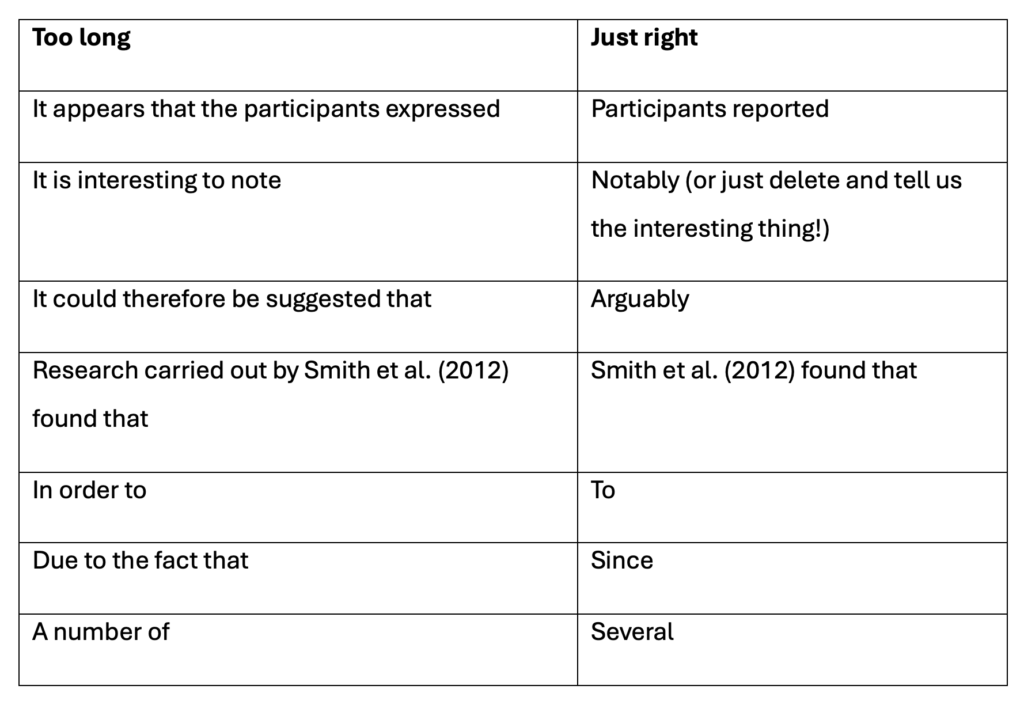
We all have stock phrases that we fall back on and reuse when we’re speaking or writing. These are often overly wordy at best and totally unnecessary at worst. They might include wording such as:

  • It appears that the participants expressed…
  • It is interesting to note that…
  • It could therefore be suggested that…
  • Research carried out by Smith et al. (2012) found that…
  • In order to…
  • Due to the fact that…
  • A number of…

All these overly wordy phrases can be replaced with more succinct alternatives, as shown below…

Read some of your work back and look out for phrases like this that you over-use, then use the search function to find all examples. You’ll be able to cut many of these back, which will have the dual benefit of getting you closer to your word count and making your work more readable.


(NB: don’t just do a find and replace – find each instance and use your judgement to work out whether it can be replaced and if so, what with!)


  1. Put your work down for a few days

In addition to these common phrases, many qualitative students tend to write in a flowery, verbose way. This is fine for a first draft. Indeed, I don’t recommend even trying to think about word count while you’re getting your initial ideas down. Capturing your interpretations and ideas is far more important in the early stages of writing.


However, if you put your too-long chapter down for a couple of days and then come back to it with a clear head, you’ll almost certainly start to spot unnecessary words. Reading your work aloud really helps with this, so if you’re struggling, try reading a page or so to yourself. You’ll instantly see cuts you can make – and then you can apply that same thinking to subsequent pages.

Taking a break can help you work out which words you can cut
Photo by Artem Beliaikin on Unsplash
  1. Trim data

As mentioned above, the data we deal with as qualitative researchers is one of the reasons we can struggle with word counts. Of course, it’s important to ensure that you are including quotes that are long enough to illustrate all the interpretations you’re making.


However, it’s often the case that a bit of data can be trimmed off the beginning or end of a long quote. Or maybe there’s a section in the middle that is less relevant? If so, you can take this out, as long as you use some notation to mark this. […] is a common way to demonstrate the removal of less relevant material.


Be careful here – don’t take out sections of data that point to a different interpretation than the one you want to make, just to strengthen your argument! Data like this must stay in and be considered. However, if the participant says something in the middle of a quote that is just not relevant to this subtheme topic, it’s fine to take it out.


  1. Stay laser-focused on your theme topics and research questions

And speaking of subtheme topics – one of the most common problems I see in my clients’ work is that data and interpretations are presented that are lovely, but not actually relevant.


Remember that no matter which qualitative method you’re using, all the material you present under a section or subtheme must feed into that topic. Similarly, each subtheme or lower-order section should feed into the higher-order theme or section. And everything you discuss in the findings section must be relevant to your research question.

Staying laser-focused on your thematic points and research question will help you write succinctly
Photo by Erfan Afshari on Unsplash

While the tips I’ve offered so far are all about trimming individual sentences, this final tip can help you to remove whole paragraphs or even pages that you don’t need. This can be painful if you’ve spent a long time reaching this interpretation, but if it’s not relevant to your research question, I’m afraid it belongs on the cutting room floor!


  1. Book PGPR

If all of this feels too much like hard work, get in touch with PGPR via the contact form below, and we help you to cut your thesis down to size by trimming individual sentences and suggesting larger areas that you may be able to edit down. We’ll be happy to help!

Making the most of your IPA data: How to beat some common errors

If you’re a student or academic conducting an IPA study, you’ll know that the data is where the magic happens. Interpretative phenomenological analysis is all about inductive work – that is, immersing ourselves fully in the data so that we can explore what’s going on for the participants and then communicate our interpretations of those experiences to readers.


This means that the quotes you choose to present in your findings section – along with the interpretations of those quotes – are perhaps the most important element of your dissertation, thesis or paper. Selecting the quotes that best illustrate the participants’ experiences and that allow you to demonstrate how you reached your findings will stand you in really good stead when you reach your viva or are facing peer review.


There are some mistakes I see frequently in findings sections, so I’ve written this blog to help IPA researchers identify the best quotes to share and present their interpretations in the optimum way.


  1. Select the data that fully evidences the points you want to make

A common issue I see is quotes and interpretations that don’t match up. When you’re immersed in your data, it’s easy to forget what your readers don’t know. This means you might state interpretations as confident findings – but without the data to back it up, examiners and peer reviewers won’t know what led you to those ideas.

When your data and your interpretations don’t match, that can be a problem!
Photo by Ian van der Linde on Unsplash

While it’s fine to communicate some contextual information without data – for example, you might explain that you’d asked a certain question just before this data was given to you, or you might set the scene for what the participant is talking about – any interpretive findings must be backed up by evidence. Therefore, once you’ve got a draft of your findings section, check all the claims you’re making about the participants’ experiences and ensure that the data that led you there is on the page.


  1. Ensuring that the quotes you present are long enough to paint a picture

Another frequent problem in the theses I look at is that the quotes are uniformly too short. Of course, not every quote you include can or should be a full paragraph, but in IPA, if all your quotes are one-liners, this is a red flag to examiners.


IPA researchers tend to explore complex, emotive topics about which little is currently known. Subjects like these cannot be adequately illustrated through short quotes alone.


Additionally, IPA analysis is about digging deep into the data – exploring the messiness, the contradictions, the hidden meanings. Analysis like this is often more fruitful if it’s been applied to longer sections of data.


If your quotes are too short, you may not be able to reach where you want to go…
Photo by Ravi Sharma on Unsplash
  1. Being truly interpretive rather than descriptive

Building on the above, another common error is that even if great quotes have been presented, the analysis that accompanies them is too descriptive. IPA is a deeply linguistic form of qualitative analysis, so we should be taking the time to really dig into the language that participants are sharing with us and considering how it adds to our understanding of their lived experiences.


Let’s take this piece of made-up data, from a made-up study about junior doctors’ mental health, as an example:


Sarah: I was working 14 hour days, was battling sleep on my drive home every night. I was fighting to do well at work, but when I got home after every shift, I was destroyed. I felt completely laid to waste. Yet I had to plaster a smile on and do it again the next day.


A researcher might state that Sarah’s long working hours are harming her mental health. And that’s correct, of course. But for an IPA study, this interpretation doesn’t go far enough.


Let’s take a closer look at this data, which contains a few striking words and phrases – note that the participant was ‘battling’ and ‘fighting’, and yet despite this, she was ‘destroyed’ and ‘laid to waste’. These words conjure up the image of a bloody battle – a battle which Sarah is losing and which has left her ruined, a shell of her former self.


Attending to the imagery that participants use in their language can help deepen analysis
Photo by Jaime Spaniol on Unsplash

Her only defence against the war zone of work is to ‘plaster on a smile’, a phrase which shows that her cheerful work persona feels like a performance. Additionally, a sticking plaster feels completely inadequate for facing the battle of work she has described.


Ok, so I made this data up and deliberately loaded it with language that could be quickly unpicked in this way, but it’s amazing how often participants pepper their words with vivid imagery that, when analysed, can provide a resonant insight into their life worlds.


Your data will almost certainly be full of interesting language, so don’t miss the opportunity to analyse it deeply. Insights like this will advance your work greatly.


  1. Show divergence as well as convergence

Any student of IPA can recite the idiom that we’re looking for divergence as well as convergence. However, it’s rare for me to see divergence mentioned in findings sections. Seeking and discussing convergence is easier and – perhaps – feels safer. But divergence is important too. Why? Because human experience is messy and varied, and cannot be reduced to yes or no experiences, much as we might wish it could be!


Divergence can take several forms. It could be that most participants report a certain emotional reaction to (say) a cancer treatment, and another reports the opposite emotional experience.


If you were conducting a study about bereavement, all participants may share the experience of anger, but for some, this takes the form of shouting at friends and family, while others take up boxing or direct their anger at themselves.


Or perhaps you’re doing a study about waiting for a liver transplant. Participants may attach a similar meaning to an experience while expressing it in very different ways. For example, most participants might describe putting their lives on hold because of uncertainty about the future. However, another might respond to the same uncertainty by embracing new experiences and living more intensely in the present. Although their behaviours differ, both accounts may reflect a shared awareness that the future can no longer be assumed.


All such examples of divergence should be included in your write-up, as they all demonstrate different aspects of the experiential elements you’re presenting through your analysis.


Life contains divergence. Seek it out in your analysis!
Photo by Eric Prouzet on Unsplash
  1. Structure your quotes and interpretations to tell a narrative

A final common error I see is a failure to structure subthemes and GETs so that they tell a coherent story. Instead, students sometimes just start with one participant, quoting all their relevant data, along with interpretations, before moving onto the next one.


No matter how insightful your analysis, this is not a good way to write up IPA. It leads to repetition and means you will miss out on showing how one element of a subtheme leads to another, which builds on the first and paves the way for the next.


As you create your PET and GET tables, think about how your findings can be structured to tell a story that best reflects the various experiences of the participants and has the potential to offer a resonant example of the meanings behind those experiences.


You will almost certainly have to keep tinkering with this structure as you write up, but that’s fine as this is part of IPA.


If you’re currently analysing IPA data and would value specialist input on theme development, interpretation, or analytic depth, my colleague Rachel Starr and I offer dedicated IPA mentoring via IPA Insights. We support researchers at all stages of the IPA process, from early coding through to thesis write-up and viva preparation.

You can contact IPA Insights here.

Alternatively, if you’re looking for proofreading or written feedback on your academic work, you can contact PGPR via this form.

Publishing your qualitative study: How to select a journal and nominate peer reviewers

Congratulations – you’ve written a paper based on your qualitative study, and now you’re deciding where to try to publish. That’s fantastic! Getting a few peer-reviewed publications under your belt is an essential step in the academic career path. However, if you’ve not done it before, the publication process can feel daunting. Don’t worry: PGPR are here to guide you.


NB: If you’re not quite at this stage yet, you might want to check out our previous blogs, How to write a qualitative paper, How to get your qualitative study read for publication and How to make your writing sing.

Congratulations: You’re ready to publish!  Photo by Yen Vu on Unsplash


Selecting a journal

  1. Make a list of journals that publish in your area

The process of reading existing research and writing your reference list will mean that you have almost certainly internalised the names of more relevant journals than you think. Jot those down, then look through your reference list for others you haven’t remembered. Ask your co-authors for their ideas. Do a Google search for ‘journal’ + your topic. This should result in a good list for you to consider.


  1. Check which are open to publishing qualitative research

This is essential! There is no point submitting your study, beautiful as it might be, to a journal that has never published any qualitative work before. Doing so will waste both your time and the editors’ time, so do everyone a favour and search the archives of your longlisted journals for the word ‘qualitative’ in the titles of published articles. If there are none, cross that one off your list.

Ideally, you want to find a journal that often publishes qual work and has published at least some articles using your methodology. Of course, there are some qual-specific journals out there, such as Qualitative Research and the Journal of Qualitative Health Research. These will always be open to qualitative work, and their reviewers will have the expertise to provide relevant, helpful feedback.

Check your chosen journal publishes qualitative research before submitting.
Photo by Yen Vu on Unsplash
  1. Make a table of each journal’s attributes

This table should include the journal’s impact factor – a number that indicates how often papers from this journal are cited and so how prestigious the journal is – their word count (you can’t publish three GETs from your beautiful IPA study in a journal whose maximum word count is 2,000), who the readers of the journal are, whether or not it is open access and so on. It could be that your co-authors have had good or bad experiences publishing in the papers on your list; if so, include that too.

Note that if you are choosing to publish in an open-access journal, your university will need to pay some rather weighty fees, so do check that they have the budget for that before pursuing that route.


  1. Rank journals in order of preference, depending on your priorities

Looking at this information in table form will help you decide which journal to target first. If you have high ambitions for forging a lofty academic career (and why not?), aim for the high-impact journals first. Just be prepared for the potential of a knock-back, and be ready to move on to the next journal on the list. If your priority is to get your research seen by other qual researchers sooner rather than later, consider a less high-impact journal with a stronger proven track record for qual researchers. (Unfortunately, these two things often go hand in hand!)

For what it’s worth, I don’t think that impact factors mean much more than a plus point on your CV. I don’t know of any academics who find papers to read based on the impact factor of the journal. Instead, just as you very likely did, other academics use Google Scholar to look for papers in the relevant area, read them, and cite the best ones, often not worrying at all about which journal those papers are in. So I never really worry about impact factors. However, if you are more ambitious in that area, I doff my cap to you and wish you the best of luck.

Deciding which journals to target takes some thought.
Photo by No Revisions on Unsplash
  1. Read through the author guidelines of your chosen journal

Once you’ve decided on your ideal journal, the next step is to carefully read over the author guidelines and ensure your paper follows them. This might involve changing your references from APA7 to Harvard (not an issue if you’ve used referencing software – a right pain if you haven’t, I’m afraid!), cutting a few words or changing from UK to US spelling. Following the guidelines as closely as possible at this stage will save you hassle later on. I recommend saving a new version of the paper and adding the journal to the title so you can revert to your original if it isn’t accepted the first time.


  1. Ensure you have cited any relevant papers from your chosen journal

This is self-explanatory! Do a quick search of recent editions of your chosen journal and include any relevant references. This will show the journal’s editors that you’ve paid attention to their publication.


  1. Write a killer cover letter

Ensure you’ve written a confident and concise cover letter before you start the submission process. This is your chance to tell the editor why their publication and readership need to read your amazing research. Again, check the author guidelines for any instructions on what to include in the letter for your chosen journal.

Sadly, academic publishing involves some rejection.
Photo by Steve Johnson on Unsplash

8. Be prepared for some rejection

Unfortunately, publishing academic work comes with its fair share of rejection, which can sting, especially when you’re starting out. Give yourself a day or two to feel the pain, then move on to the next journal. Keep working through your list until you find someone who recognises your genius and says yes!

If a journal rejects your paper but gives you some feedback, read that feedback carefully. If the reviewers have said anything you agree with, redraft the paper to smooth out those issues. If you don’t agree, move on. The good news is that the longer you do this, the easier it becomes to shrug off any difficult feelings that come with rejection and keep moving forward.


Submitting your paper involves filling out a long, complex online form and is often more frustrating than you want it to be! Give yourself a good hour or so to complete this process, and ensure that you have all relevant info to hand before you get started, such as your co-authors’ contact details and your cover letter. If possible, look through the form before you get started so you can spot anything you might need to ask your supervisor about in advance.

One thing you will need to do is nominate peer-reviewers; that is, experts in your field who you would ideally like to review your paper. Peer reviewers decide whether your work is ready for publication and, if not, what needs to change. It is extremely rare for a paper to be accepted with no revisions, so be ready to respond to your reviewers’ comments before publication.


How to nominate peer reviewers:

  1. Have this discussion with your co-authors before you submit

It’s really frustrating to be 75% of the way through submitting your paper before you realise that you haven’t discussed potential reviewers with your co-authors, as that means you have to pause the process to have that conversation. Therefore, I recommend going into the submission process with a list of agreed-upon potential reviewers to nominate, along with their institutions and contact details.

Talk to your co-authors about which peer reviewers to nominate.
Photo by Brooke Cagle on Unsplash

2. Who can’t review your work?

For obvious reasons, you cannot nominate current or recent co-authors, someone at your institution, a mentor, close colleague or friend. Therefore, tempting as it might be, don’t put any of those friendly faces on your list.


3. Who should review your work?

As mentioned above, your nominated reviewers should be experts in the field. I believe it’s more important that these people are qualitative researchers (or at least open to qualitative research) than that they are well-versed in your exact topic. Otherwise, you run the risk of reviews from people who don’t understand qualitative research and will waste your time asking about generalisability or insisting that you should have reported data saturation in your three-participant IPA study. If you can think of people who are qual researchers and also experts in your topic, all the better. You can find people like this by looking at who wrote the work you’ve cited and asking your co-authors for ideas.


4. Make sure you’ve cited their relevant work

Once you’ve decided on a few names, check whether these people have published a relevant paper that you have somehow missed. If you find something important, cite it. Everyone is susceptible to flattery. Plus, if the work is relevant, the reviewers will certainly point out that you’ve missed it, so this saves everyone time.

Make sure you’ve cited your ideal peer-reviewers in your paper.
Photo by Daniel Thomas on Unsplash

5. If possible, list more than two people

Bear in mind that your nominated reviewers are not under any obligation to say yes. Academics are stressed, busy people and reviewing is not paid work. For example, I probably review only one in every five papers I’m asked to read. I say no to any quantitative papers or those I have no expertise in at all (so again, do everyone a favour and only nominate people who have the relevant knowledge), but also have to say no to some fascinating-sounding papers because I don’t have the time to read them. Therefore, the longer your list of potential reviewers, the better.


In my experience, if a paper is about a strong, important study and you are targeting relevant journals, you will only need to try two or three publications before you find the right home for your work. The more experienced you become at this, the more likely it is that you’ll find the right journal the first time around.

If you need any help preparing your study for publication, contact PGPR using the form below. We are qualitative experts who offer proofreading and feedback to postgrad students like you.

Common thematic analysis pitfalls – and how to avoid them

If you’re a qualitative researcher, you will be familiar with Braun and Clarke’s reflexive thematic analysis (RTA). Originally outlined in their 2006 methodological paper “Using thematic analysis in psychology”, it is probably the most common ‘first foray’ into qualitative research for psychologists. Since 2006, Braun and Clarke have refined and reworked their 6-step method, producing papers, books, YouTube videos (from both Clarke and Braun) and an entire website dedicated to supporting the conduct of quality RTA.

Despite this clear and helpful guidance, we regularly come across a handful of common errors in the conduct and write-up of RTA studies here at PGPR.

1. Themes do not emerge!

If you’ve ever used the term “the themes that emerged…” or similar in your RTA study, you’re in good company – it’s an error so commonly commented on that it’s spawned its own meme.

Pin badge (now discontinued, sadly) designed by Dr Heidi R Green, “Science On A Postcard”

But why does this seemingly innocent phrase cause so much uproar in the RTA community? It comes down to its positivist implications: saying that the themes emerged, were identified, or even were found in the data, suggests that, if we look hard enough, we can find objective themes which truly exist, regardless of the researcher’s analytic process.

Themes, in an RTA sense, are not real – they are constructed through the analytic process. Braun and Clarke, true to form, say it best: “In reflexive TA, themes are generated, created or constructed (for example), they are not identified, found or discovered, and they definitely don’t just ‘emerge’ from data like a fully-grown Venus arising from the sea and arriving at the shore in Botticelli’s famous painting” (Braun & Clarke, 2022). Is this semantic pedantry? Some might argue that it is, but this edict has become the shibboleth by which seasoned RTAers recognise whether or not their students have familiarised themselves with Braun and Clarke beyond 2006!

2. So where do themes come from..?

They are developed! You won’t know what your themes will be until you’ve engaged in the analytic process, so none of this “we expect the themes to be…” nonsense in your introduction, please. Depending on your research aims and specific approach (inductive, deductive – RTA is delightfully flexible), you may have specific areas of the data you want to focus on, but try to also allow for unexpected insights. And definitely steer clear of topic summaries as theme names – a theme named “how patients use online patient portals” doesn’t tell an interpretative story (and probably doesn’t go much beyond the initially stated research aim). But theme names such as “taking ownership of my healthcare” communicates a core message – a message that cannot be conceptualized prior to analysis.

To put it simply: themes come from a combination of the data, the analytic process, the sociocultural context in which the data was collected and analysed, and the specific context that you, as the analyst, bring to the analytic process. If, for example, Johanna and I were to analyse the same set of transcripts, we would very likely construct a different set of themes. If we were to analyse the data together, a third distinct set of themes would probably be developed. And that is because…

3. You are a tool of the analytic process

…not a contaminant to be contained. Again, this comes down to a question of philosophical frameworks – RTA is not constructed on a bedrock of positivist paradigms.

Photo by Lachlan Donald on Unsplash

Unlike in much quantitative research, the aim of RTA is not to control for or eliminate researcher bias – the reflexive aspect of RTA acknowledges that the researcher plays an active role in developing themes. As the analyst, your position, context, and yes, bias, bring something unique to the analytic process – so own it, don’t deny it. Engage reflexively throughout the analytic process to explain how and why you developed the themes as you did. This can be done as a group process, with multiple coders or analysts, but not in an effort to “control for bias”. Inter-rater reliability has no place here.

4. Leave the concept of saturation to the grounded theorists

In a similar vein to “inter-rater reliability”, we all too often read references to saturation in RTA studies. I wonder if this is in an effort to appease positivist editors or supervisors, or a desperate bid to cling to something concrete to guide sample sizes. You might be showing your positivist hand if you insist that “interviews will be conducted until data saturation is reached”. The concept of saturation is that there comes a point after which “no new information” is produced by further interviews (or focus groups, or whatever mode of data collection is being undertaken). This makes sense in a grounded theory study, where the analyst is interested in finding the solution to a specific problem and will use theoretical sampling to simultaneously collect data as they analyse, thus allowing them to narrow down further and further towards an understanding of their new theory.

However, in RTA, Braun and Clarke have been pretty clear on the topic: “…when it comes to reflexive TA, data saturation is not a particularly useful, or indeed theoretically coherent, concept” (Braun & Clarke, 2019). The more data you collect, the more possibilities for interpretation arise – the themes you develop after 10 interviews may look very different from the themes you might have developed if you conducted 20 interviews. You’ll just have to make a pragmatic, interpretative judgement (and possibly be guided by Braun & Clarke’s Thematic Analysis FAQ). Try to be comfortable with the uncertainty.

5. There isn’t just one approach to Thematic Analysis

…although you’d be forgiven for thinking so. Braun and Clarke’s 2006 methodological paper “Using thematic analysis in psychology” has several hundred thousand citations now, and their approach is used across a broad range of disciplines. However, theirs is not the only way, even if it is my favourite – clearly, I’m not alone in this! There are other modes of thematic analysis, some of which have more neo-positivist roots. Thematic analysis’ multiplicity is part of the reason why, post-2006, Braun and Clarke chose to differentiate by naming their method reflexive thematic analysis.

If you are undertaking an RTA study, be explicit about this by naming it as such – and try to cite sources beyond that 2006 paper, to demonstrate your reflexive chops. And don’t forget: be reflexive!

If you want help ensuring that your RTA is working as well as it can, just get in touch with us via the box below. We’ll be happy to help.

Spotlight on Johanna

PGPR is the brainchild of Johanna Spiers, business owner, qualitative researcher and proofreader extraordinaire. Johanna loves running PGPR and working with her clients, and she appreciates how hard it can be to turn the thesis you’ve spent months and years working on over to her to edit and/or critique.


As such, we thought it might be useful for Johanna to share a bit about who she is, where her training comes from and how she came up with the idea for PGPR. We’re hoping this will help you feel confident that your work will be in good hands when you send it to us.


Johanna is happy to help with all your proofreading and feedback needs

Johanna says…


On getting into qualitative research

My first qualitative study was an undergrad IPA project that I completed under the guidance of Jonathan A Smith at Birkbeck University. The project was about academic mothers juggling their work and family demands. I was hugely lucky to be supervised by the man who created IPA; I found his insights and tutelage inspirational.

I came from a creative background – my first degree, completed back in the late 1990s, was in creative writing, and when I’m not helping PGPR students, I write fiction. I love exploring the nuances of words and delving into their deeper meanings. Plus, I’ve been drawn to understanding relationships and diverse perspectives since childhood.

As such, I found IPA’s combination of deep, idiographic textual analysis and psychological underpinnings hugely attractive.

Indeed, I loved doing that study so much that I applied to do my PhD with Jonathan as soon as my undergrad was over. My PhD – which was about the experience of living with and being treated for renal failure – led to three publications, which you can read here, here and here.


Johanna’s first qualitative project was about working mothers

On the qualitative projects she’s worked on:

Since finishing my PhD, I’ve worked on research projects at universities including Hull, Bristol, UCL, Birmingham and Surrey. The topics I’ve researched have tended to be related to health conditions – either physical or mental – and include areas like living with an ileostomy, the mental health of healthcare professionals, adherence to HIV medication and an evaluation of a dementia healthcare program.

While I have continued to use IPA, my first (and true!) qualitative love, I’ve also been fortunate enough to work on studies which required me to use a range of other methodologies, including thematic analysis, grounded theory, realist evaluation and even, on one shocking occasion, quantitative methods.

I’ve also co-authored several literature reviews, including an integrative review of postvention guidance and a rapid review of reviews of dementia healthcare programs (in press).

This experience means that I am well qualified to offer feedback on a range of studies and methodologies – so your work is in good hands when you send it to me.

Your work is in good hands when you send it to PGPR 

Photo by Izzy Park on Unsplash


On her proudest publication:

Of all the research I’ve worked on, I have felt most passionate about the series of studies I completed with Dr Ruth Riley about various aspects of healthcare professionals’ mental health.

I love our NHS and feel very strongly that it needs to be better funded and the staff who work for it better looked after. As such, being able to speak first-hand to GPs, junior doctors and a range of other NHS workers about their jobs and mental health was a true privilege.

My proudest – and most cited! – paper comes out of one of those jobs. This is a paper I especially love because it highlights some of the struggles faced by NHS workers whilst also offering help to qualitative students, as I explain how to analyse one dataset (about the distress of GPs) with both IPA and thematic analysis.

You can read that paper here.


On the journey that started PGPR:

As I mentioned above, I started life as an editorial person rather than a scientist. After completing my degree in creative writing, I moved back to my hometown of London and worked in the editorial world, writing Teletext (remember that??) for various cable channels and then sub-editing copy on a range of magazines and newspapers.

This work taught me how to make words work in the most efficient way possible. At the same time, I continued to work on my fiction (an example of which you can read here, if you’re interested).

While I was doing my PhD, I worked on the QMiP Bulletin, eventually serving as editor for a brief spell. I think I rather terrified everyone else on the team by introducing glossy magazine-level proofreading standards to what was a volunteer position. I loved that work – combining my new psychology knowledge with my trusty editorial skills felt like a dream for me.

In 2017, I finished work on a postdoc study at Bristol and started applying for lecturing positions. However, my heart wasn’t really in the search – lecturing looks like arduous work (hats off to all the supervisors out there toiling away at the frontline!) and I was still plugging away at my fiction writing.

So I decided to see if any postgrad students wanted help proofreading their theses, something I felt uniquely qualified to offer.

I was amazed by the response – PGPR has been running ever since then!

PGPR has been helping postgrad students since 2017

On PGPR’s journey

PGPR has undergone several iterations in the nine years it has been running. At first, it was just me and my laptop. However, I was so quickly overwhelmed by clients that I started recruiting other qualitative and editorial experts to take on the work I didn’t have time for.

At one time, PGPR had 10 proofreaders on the books, a fantastic admin assistant and a business manager.

These days, we’re a more humble affair: it’s now just me and Astrid taking on work, and I’ve gone back to doing all my own admin, meaning you get the personal touch from the moment you contact us.

I love the proofreading work I do for all you lovely students. I get to read about such a range of fascinating topics. My clients are a warm, clever and funny bunch, and I feel lucky to be able to help them on their roads to success. I love hearing about vivas passed and papers published.


If you’d like Johanna to proofread some of your work or offer feedback, you can get in touch via the form below. She’ll be happy to hear from you!

Five more common problems for postgrad students and how PGPR can help

In a previous post, we covered some of the common problems we support postgrad qualitative students with, to help you to tighten up your writing. In this post, we’re covering a few more.

1.      Overuse of conjunctive adverbs

Conjunctive adverbs are words or short phrases used to transition from one clause to another. You’ve used them all your life, and you might not have known they had a term – words like “however”, “moreover”, “in conclusion” and “additionally” are all conjunctive adverbs, and can be useful for creating narrative direction or emphasis. However, over-use can make your writing clunky, cluttered and overly formal. Moreover, starting every sentence with a conjunctive adverb can be a jarring reading experience, detracting from the content of your writing.

Take those two previous sentences as an example; arguably (there’s another one), the “however” is a useful signifier of a change in direction (from the “usefulness of conjunctive adverbs” to “writer beware”). The following sentence didn’t need to start with “moreover” – it stands up fine on its own. I could have started the sentence before this one with another conjunctive adverb, such as “Arguably, the following sentence…”, but did it need it? Arguably, it didn’t. Next time you review your writing, try highlighting every time you use a conjunctive adverb – can some of them bear pruning?

Conjucntive adverbs can be useful linking devices but use them sparingly!

Photo by Zulmaury Saavedra on Unsplash

2.      Badly positioned ordinal and sequencing adverbs

In academic writing, we often use ordinal or sequencing adverbs to structure points in our argument – firstly, secondly, lastly, finally. They can help your reader to identify discrete points within a broader claim, or guide them through the order of your ideas. But use them wisely!

  • If you’re going to use ordinal adverbs, use them clearly and consistently – for example, if you tell your reader that there are three main criticisms of a theory, don’t start with “firstly” and then fail to indicate “secondly” and “thirdly”, as they may not be able to clearly identify where one criticism ends and another begins.
  • If you start a clause with “finally” or “lastly”, it really should be the final or last clause of that argument – don’t use “finally” in the middle of a paragraph and then go on to make several other points related to the argument.

3.      Making analytical claims that aren’t properly supported by data

A common refrain from markers and reviewers everywhere is “citation needed”, usually referring to claims made that aren’t supported by published peer-reviewed literature. If you’re a qualitative researcher, you also need to ensure that analytical claims are clearly supported by your data. When you make statements about the phenomenon you’re researching, is it evidenced in the data you’re presenting, or does it just “feel right”? Make sure that your reader can follow your reasoning by presenting relevant quotations from your participants and explaining your analytic process.

4.      Hedging

In writing, “hedging” is using language that indicates uncertainty. You might be familiar with the term “hedging your bets”, to protect yourself from potential losses by placing bets on multiple possible outcomes.

Sometimes, hedging can be appropriate, such as when you are exploring multiple possible interpretations of findings (e.g., “this may indicate…”). However, don’t hedge everything – overuse of hedging can make your writing less direct or certain, and this isn’t appropriate when you are stating things that are certain or unambiguous.

For example, instead of writing “In this chapter, I hope to demonstrate…”, simply state “In this chapter, I will demonstrate…” – not only will this make you sound less apologetic, but it also improves clarity and conciseness, reducing the burden on your reader (who otherwise has to cut through the waffles of mights and maybes!)

Don’t let your reader get lost in the hedge maze

Photo by Field Cottage on Unsplash

5.      Using too many summaries and repetition

Clear metalinguistics – explaining “this is what I’m going to cover” and “in summary, this is what I’ve covered” – can be useful to guide your reader through your writing, but don’t overdo it. If you have just explained something in good detail, don’t start the subsequent subsection with a summary of what you’ve just covered. Not only is this repetitive, but the extra clutter it creates potentially makes it harder for your reader to follow the narrative thread of your writing.


Need help pruning your hedging or ordering your adverbs? We can help you to make your writing shine – just contact us via the box below!

Spotlight on Astrid

At the time of writing this blog, PGPR consists of just two people – Johanna Spiers, the business owner – and Astrid Coxon, proofreader and qualitative expert extraordinaire.

In this blog, you can get to know Astrid and hear about why she will do an excellent job on your paper, essay or thesis. Astrid says…

On getting into qualitative research:

My qualitative education started when I studied health psychology at the University of Surrey, where I had the absolute privilege to be taught by (the now deservedly retired) Professor Adrian Coyle. As well as being playful and practical in his methods (teaching us the basics of thematic analysis by getting us to code Dolly Parton lyrics), he was also incredibly encouraging.

We bet Dolly loves qualitative research…

Photo by Wes McFee on Unsplash

I hear stories of psychology students getting the most brief and basic whistle-stop tour of qualitative methods, but we were supported to complete full projects following the famous six-step approach to thematic analysis (Braun & Clarke, 2006 ), which should be on a bingo card at qualitative conferences!

That experience completely changed the trajectory of my academic life. Before my time at Surrey, I was a dyed-in-the-wool* quantitative psychologist – now, I’m so far down the qualitative rabbit hole that I can barely remember the most basic functions in SPSS.

*Choice of wording deliberate – my project for Prof. Coyle’s module involved interviewing members of knitting groups!


On the qualitative projects she’s worked on:

I’ve been largely involved in healthcare-related research, including the stress experienced by ambulance dispatch personnel, the implementation of enhanced recovery hip fracture care pathways (my PhD research), and more recently, people’s experiences and perspectives of receiving medical test results via online patient portals.


On her favourite qual methods:

I’m a big fan of reflexive thematic analysis. Maybe because that methodology holds such fond formative memories for me (being the first approach I was taught), maybe it’s because Braun & Clarke are just very cool and actively involved people, maybe it’s because it’s so accessible and endlessly adaptable, or maybe because it’s the approach that spawned its own meme!

(Go and do an image search of the phrase “themes do not emerge” – and yes, I have the pin badge, and yes, it makes for a good conversation starter!)

On her proudest publication:

I’m not sure I can say it’s “mine”, but I think the paper I’m most proud to be co-author on is one first-authored by one of my MSc students. I work part-time as an online teaching fellow at King’s College London, and while I work with some brilliant students, the nature of the course (MSc Psychology & Neuroscience of Mental Health) and the timescale in which it’s delivered makes it quite rare for them to be able to conduct primary research for their dissertation projects (most will either do research proposals or critical reviews).

As a result, I don’t routinely get the privilege of supporting students to translate their dissertations into articles for potential publication. But last year, I was approached by a student (Steve Siddals – remember the name, I’m certain he will go far!) who was extremely passionate about his chosen topic (people’s experiences of using generative AI chatbots to support their mental wellbeing), and I supported him through the KCL ethics process, data collection, analysis and write-up.

After he finished his MSc, we translated his dissertation into an academic manuscript, which was published in NPJ Mental Health.

Here at PGPR, we love helping students

Photo by Walls.io on Unsplash

Note that you can read more of Astrid’s excellent publications via her Google Scholar page.


On getting involved in PGPR:

Johanna and I first met at a BPS Qualitative Methods in Psychology (QMiP) section conference in 2015 (at Anglia Ruskin Uni in Cambridge).

I was still a baby academic then – I’d only recently started my PhD and was still trying to feel my way around the weird and wonderful world of qualitative methods. Both Johanna and I had blue hair at the time, which is as good a reason as any to strike up a conversation with a stranger at a conference! Turns out, a groovy sense of style wasn’t the only thing we had in common, and I think we both had a feeling that we’d be in touch for the long haul.

In 2018, Johanna recommended that I take over as editor of the QMiP’s “Bulletin” journal and coached me in the early stages of that role. Then, a year later, Johanna got in touch about her proofreading business. She told me how busy things had been and asked if I would be interested in some work. The rest is history. It’s weird to reflect on how long ago that was.

Johanna and I have only actually been in the same physical space as each other a handful of times, but that hasn’t gotten in the way of a solid friendship!


On what she loves about PGPR:

I’ve had the opportunity to read some genuinely fascinating research that I wouldn’t have otherwise had cause to read. Whilst I do get to read some great dissertation projects by my MSc students, they all fall within my subject area (mental health of healthcare workers or therapy-adjacent topics) – working for PGPR, I’ve read about immigration law, peer coaching in the fire service, dogs in offices, and much, much more besides.

We can proofread research on dogs in offices – or even FROM dogs in offices!

Photo by Pavel Herceg on Unsplash

I particularly enjoy formatting work – there’s something very satisfying about applying consistent heading styles, table/figure captions, and generating tables of contents to produce a professional-looking document for a client. The final finishing touches make a big difference!


On life outside of PGPR:

When I’m not proofreading, I can either be found at the beach walking my dogs, or on the sofa knitting! Sometimes, I even knit for the dogs.

Ok, two pictures of dogs in a row – but who could resist this picture of Astrid’s dog in her knitted jersey?

If you want to book Astrid for any proofreading, feedback or formatting work, just get in touch via this box.


Five common problems for postgrad, qualitative students – and how PGPR can help

Here at PGPR, we’ve been helping postgrad qualitative students polish and refine their work since 2018. We love our work and our clients – you guys are dedicated, friendly and warm, and you all do such amazing research. We always enjoy helping you, so in that spirit, here’s a list of some of the problems we see cropping up time and time again – and some ideas for how to avoid them.


1. Dictionary swallowing

Postgrad work is a few steps up from undergrad – steps that can initially feel huge and intimidating. One of the hardest things can be getting to grips with all the new terminology you’re suddenly dealing with.

Phenomenology, hermeneutics, heuristics, epistemology, ontology – it’s enough to make your head spin.

Getting to grips with all these concepts and presenting your understanding of them can be tricky. Making it even more complex is the fact that academic writing follows a particular style and has certain (often unspoken) rules.

Read the dictionary by all means – but don’t swallow it!

Photo by Emmanuel Ikwuegbu on Unsplash


A common response to these factors is to write in sentences and paragraphs that are so chock-full of multi-syllabic words and awkward passive phrasing that they must be read six times to be understood. So where you could have said:

Ontology and epistemology are two key ideas in philosophy that help us understand reality and knowledge.

Instead, you will say:

Ontology and epistemology constitute the foundational pillars of philosophical inquiry, delineating the fundamental nature of reality and the mechanisms through which knowledge about that reality is ascertained.

As you can see, this longer and more complex sentence is in no way better. The first and best rule of any writing is ‘omit needless words’ (Strunk and White, 1918), and that definitely applies here.

When we at PGPR see language like this, it can make us wonder whether the client really understands what they are describing. Therefore, first, check that you fully understand the concepts you’re writing about. Try explaining them to a friend and then writing that explanation down. What you get from this exercise will almost certainly be better than striving to write in ‘academise’.

Try checking out this quick video where Steven Pinker explains why many academics write so badly – it’s not just the students who do this!


2. Analytical teething troubles

A common problem with qualitative work is that the analysis needs to be refined further. Perhaps you need to dig deeper into the participants’ language. Maybe your themes read like a list of different experiences rather than a discussion of what brings those experiences together. It could be that those themes or codes are disorganised.

Is your analysis working as hard as it could?

Photo by Firmbee.com on Unsplash


If this is the case for you, fear not! Qualitative analysis is hard, and it’s rare for students (or academics) to get it ‘right’ the first time. Collaboration and inspiration from supervisors, colleagues, research groups or from PGPR can be beneficial for pushing your ideas forward and doing justice to your lovely data.

If you could do more with your data, contact us via the box below and you can book in for some feedback.


3. Not knowing when to quit…

When writing a postgrad thesis, you’re a bit like Aerosmith – because you don’t want to miss a thing. You’ve put your blood, sweat and tears into this thesis, so it’s entirely understandable that you will want to ensure nothing gets missed out.

Since the thesis is your baby, it might be hard to determine what needs to be included and what is less essential.

Additionally, many of our clients have trouble trusting that readers are paying attention to their work, which means they can repeat the same ideas and concepts, in the same level of detail, many times throughout their thesis.

If you’re struggling with your word count, put your thesis down for a bit. Returning to it with fresh eyes will help you spot areas you can cut out or points you’ve repeated.

Plus, did you know that PGPR offers a word reduction service? We can cut up to 20% from your work for a small additional fee when you book in for proofreading. Another pair of eyes can be useful in murdering those darlings and getting your work as sharp and shiny as a diamond.


PGPR can help you snip back those extra words.

Photo by Alex Gruber on Unsplash


4. DIY ToC

The table of contents (or the ToC) can be a puzzling beast to get right. Page numbers will keep shifting as you keep adding to your masterpiece. Headings and subheadings shift around and get amended – and many of our clients think they need to deal with this manually.

Here’s the fantastic news – you can leave your ToC to us entirely. With just a few simple clicks and highlights, our formatting whizz Astrid can create an interactive table of contents that you can update when you amend your thesis.

If you’re coming unstuck with your ToC, book in for our formatting service and we will do all the heavy lifting for you.


PGPR can do the heavy lifting for you

Photo by John Arano on Unsplash


5. Deadline emergencies

Look – we get it. Time goes quickly, life is hectic. All of a sudden, your postgrad deadline is only two weeks away, and you still haven’t booked that brilliant proofreading and feedback service you heard about. (That’s us, BTW!) If this is you, don’t worry – we will do our best to still fit you in.

However, if you can send your work earlier, we hugely recommend this. Why? Well, for a start, a longer period between us looking at the work and you submitting your thesis gives you longer to respond to our amendments. This is especially useful if you’ve booked feedback. Sometimes an analysis chapter might benefit from two rounds of feedback, which means that waiting until you’ve dotted all the ‘i’s, crossed all the ‘t’s and are eager to submit can lead to problems.

Of course, sometimes we are fully booked, so if you wait until the last minute, we might be unable to help you, which would be a shame.

We’re happy to look at individual sections of your thesis over weeks, months or even years. You don’t have to wait until everything is finished to book our services. If you’ve got a lit review you’ve finished but you’re waiting for ethics to come through so you can recruit the participants, send us that lit review and you can be doing your amends while you wait. And then when the deadline comes around, you’re ahead of the game and can smile the smile of the smug!


We love making our clients smile!

Photo by Freddy Mishiki on Unsplash

Whatever your issue, if you’re a postgrad qualitative student needing extra help, we are here for you. Just contact us via the box below and tell us what’s going on for you.

Brilliant resources for qualitative postgrad students

Despite their growing popularity, using qualitative methods as a postgrad student can be lonely. Perhaps you’re the only person using IPA in your department, or your supervisor doesn’t know the difference between classical and constructivist grounded theory.

Whether you’re feeling alone or just want more networks and resources to help you on your qualitative journey, the list of resources below will likely be helpful. Check it out!

Research is much easier with friends to help you out.

Photo by krakenimages on Unsplash

Interpretative phenomenological analysis

• The IPA groups.io forum is a fantastic place to chat with other students and academics using IPA. Sign up here to send and reply to emails from other group members. You can ask questions or help others with the dilemmas facing them. Forum regulars include many of the big names of IPA, including Jonathan Smith, Michael Larkin, Richard de Visser, Elena Gil-Rodriguez (more on her shortly!) and yours truly.

• Dr Elena GR, who I have mentioned above, runs online workshops designed to help IPA students. Her courses can help you with interviewing, analysis and situating your findings within the literature. You can book her workshops via her website, which is also a fab resource for all things IPA.

• Additionally, these are some of the best books and papers you can read to help you on your IPA journey. The original Smith, Flowers, and Larkin Bible has a new edition; check it out here. Smith and Nizza have written a fantastic short book on IPA Essentials. This paper from Smith and colleagues lays out how to produce excellent IPA, and this paper from Farr and Nizza reviews longitudinal IPA.

• Finally, the official IPA website from Birkbeck University, where Jonathan Smith teaches, includes any upcoming IPA events, exemplar papers and regional/international contacts for IPA discussions and networking.

Joining the IPA online forum can be very useful.

Photo by Chris Montgomery on Unsplash

Thematic analysis

• The best place for any TA student to start is with papers from Braun and Clarke, whose seminal 2006 paper on the methodology has, at the time of writing, been cited an incredible 22,3418 times! The pair have written many papers which are also essential reading for TA students since, particularly the paper which defines reflexive TA (RTA).

• Braun and Clarke have also recently written a paper offering useful reporting guidelines for anyone using RTA.

• If you’re struggling to understand the difference between thematic analysis and IPA, check out this paper I wrote with my colleague Ruth Riley in 2019.

Qualitative students have a lot of reading to do!

Photo by David Iskander on Unsplash

Grounded theory

• Whether you’re brand new to Grounded Theory or are mid-way through your project, do yourself a favour and get connected with Grounded Theory Online. Helen Scott and Tom Andrews, both GT experts, run excellent online troubleshooting and coffee morning sessions via the site. You can also book 1-2-1 mentoring sessions via this site. I was mentored by Helen whilst completing a GT study and can highly recommend her help.

• There’s an absolute wealth of writing about GT out there. Which books and papers you look at will largely depend on which of the GT variations you decide to use, but some great starting points are the Discovery of Grounded Theory by Glaser and Strauss, Constructing Grounded Theory by Kathy Charmaz and Doing Grounded Theory by UWE Flick.

Finding the right mentor can be beneficial.

Photo by Christina @ wocintechchat.com on Unsplash

General resources for qualitative students

• SAGE research methods. This is a huge site that contains examples of worked qualitative methods, including IPA, TA, GT, and discursive psychology, as well as sections on how methods are related and how to plan your project.

• ResearchGate and Academia are social networking sites for academics, where you can upload your papers, search for other people’s papers and message people whose work you admire. LinkedIn is also a handy social media site for connecting with other academics.

• The Qualitative Research in Education Facebook group is an active and friendly community that is well worth signing up for.


Here at PGPR, we offer feedback to students using IPA, TA, GT, and other qualitative methods. Just get in touch using the contact box below if you’d like to book our services.

Why Post-Graduate Proof-Reader Beats AI at Proofreading Academic Work

As artificial intelligence tools continue advancing at a rapid pace, you might be wondering what value professional proof-readers like us can add to your postgrad thesis. However, when it comes to work that is as important as your amazing research, the human proof-readers at PGPR offer a better service than even the most advanced AI available today.


Superior accuracy

AI proofreading tools are getting better all the time when it comes to catching basic grammar, spelling, and punctuation errors. However, PGPR’s friendly and professional team remain more accurate and can catch some subtle errors that AI tools miss.

We can spot things that AI might miss. Photo by Emiliano Vittoriosi on Unsplash


Our team of friendly proof-readers has a deeper understanding of the intricacies and nuances of language, which we have gained from our academic and editorial backgrounds. We can identify and correct complex sentence structure issues, convoluted phrasing, unclear arguments and inconsistencies in tone. We’ll correct issues with tense, pesky Oxford commas and jarring language in a way that AI just can’t handle.


We have the expertise…

PGPR was invented to help postgrad students who are using qualitative methods. As such, our team includes experts in interpretative phenomenological analysis, thematic analysis and grounded theory. However, we also have editors with experience in psychotherapy, education, creative writing, history and comms.


If you book one of our team for feedback, we might point out that a key piece of research is missing from a literature review or use our expertise to question assumptions that you have missed due to your closeness to your topic. We will also offer detailed thoughts on your analysis, data and use of methodology. We can delve deeper and provide specialised insight to strengthen your important work. AI tools lack this critical thinking and depth of subject matter expertise.

The PGPR experts are happy to share their knowledge with you. Photo by KOBU Agency on Unsplash


When it comes to qualitative research, that human touch is always going to be several steps ahead of AI. Qualitative data and analysis are nuanced, messy and very human. That’s what makes them fun, right? As advanced as AI gets, it won’t be able to spot the linguistic and thematic intricacies that we can help you with.


If you book one of our video consultations, you can talk over your questions with one of our team, who will be able to use their knowledge to look at your data and offer their expert thoughts on the challenges you’re having.


Clear communication for improved learning

One common complaint about AI proofreading tools is that students might not fully understand why a particular change is suggested or how to fix an identified issue. While AI flags problems, it doesn’t explain them. This provides little opportunity for you to improve your writing skills.


PGPR’s proof-readers take the time to communicate clearly with clients to explain identified issues and provide guidance on strengthening your academic writing. We tailor our feedback and instructions to your level of understanding so that we can help maximise your learning. Our aim is not just better papers now, but better writers for the future. Plus, if you have any questions after you receive your work, we’re always happy to answer or explain.


Customisation for individual needs

Every client and assignment is unique. Our proof-readers customise their editing style, comments and approach based on what you need. For advanced students, we may focus on refinement and polishing. We provide more guidance on structure, style and basic grammar for those newer to academic writing.

PGPR’s help is tailored to snugly fit your needs. Photo by Salvador Godoy on Unsplash


We have recently introduced a light proofreading service, as well as our standard proofing, plus you can also book PGPR for feedback and video consultations. Get in touch and chat with our wonderful admin assistant Tilly to find out what is the best service for you.


The human touch

Completing a postgrad project can be lonely, especially if you’re the only student using qualitative methods in your department. Working directly with a caring, encouraging human proof-reader will give you a personalised experience that builds confidence and relieves stress. We can answer questions, alleviate worries, provide positive reinforcement when needed, and instil confidence in anyone who might be feeling intimidated by academic writing conventions.


Having an expert understand the thought process you were having when composing your paper and what you’re aiming to achieve can take much of the isolation out of writing. Our one-on-one interactions are tailored to each client’s needs. The human touch that AI lacks helps students feel supported while improving their work.

The friendly humans at PGPR are always happy to help. Photo by Matthew Henry on Unsplash


Proven trust and reputation

PGPR has helped hundreds of clients over the years to earn better grades and advance their academic careers. Our experienced team has a strong reputation built on proven results that you can trust. We have received extensive praise and feedback; you can read case studies from some of our satisfied clients here.


In conclusion…

PGPR’s team of academics, editors, researchers and language experts provides a customised proof-reading experience with a human touch that artificial intelligence just can’t replicate. For any student who needs to submit their absolute best work, our proven expertise, nuanced understanding and caring supportive approach remain invaluable. AI has its uses, but when the crucial elements of your thesis are on the line, PGPR’s human insight can offer you the best service. Get in touch to hear more about our services.